Quantum computing promises revolutionary computational power, yet its journey from theoretical breakthrough to practical application is proving complex. Despite major financial backing from governments and private industry, the technology faces large hurdles in delivering tangible, widespread benefits. Major developers are revising their aggressive roadmaps, and the industry is increasingly embracing hybrid approaches that blend classical and quantum systems.
Understanding Quantum Computing’s Core
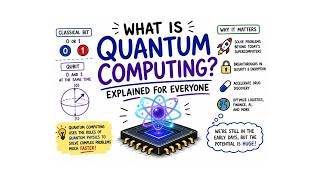
At its core, quantum computing uses quantum bits, or qubits, which use quantum properties. Unlike standard bits that are either 0 or 1, qubits can exist in superpositions of both states simultaneously. This means a single qubit can represent both 0 and 1 at the same time. When multiple qubits are combined, the number of possible states grows exponentially. For example, three qubits can represent eight states.
The real power, however, comes from entanglement. This is a quantum phenomenon where qubits become linked, allowing their states to be interdependent. This creates a vast number of combined states for calculation, far beyond what classical computers can manage. This ability to explore many states at once forms the basis for the “quantum advantage.” It enables certain calculations to be performed much faster than on conventional machines.
The Elusive Quantum Advantage
Achieving this quantum advantage in a meaningful way requires a large number of qubits. Experts estimate this range to be somewhere between hundreds of thousands to a million stable qubits. Currently, building and maintaining such large-scale quantum systems remains a major engineering challenge. The delicate nature of qubits makes them prone to errors and decoherence, which means they lose their quantum properties quickly.
Early claims suggested that even “noisy” quantum computers, with their inherent errors, could have practical uses. Unfortunately, these uses have not materialized. This has led to a re-evaluation of earlier optimistic timelines and a shift in industry focus.
Roadmap Revisions and Hybrid Approaches
Major players in the quantum computing field have quietly revised their aggressive development roadmaps. For instance, a few years ago, IBM projected having more than 4,000 qubits by 2025. They also planned to scale to 10,000 and more by 2026. These specific qubit targets have since disappeared from their current plans.
Instead, the industry is increasingly adopting hybrid approaches. These systems combine conventional supercomputers with quantum processors. Terms like “quantum-centric supercomputing” describe these blended systems. For example, IBM recently announced using such a system to simulate a large protein complex. However, most of the calculation in this instance was performed by the classical supercomputer. The results were also comparable to purely conventional methods. This blending of technologies makes it difficult to discern the specific contribution or advantage offered by the quantum component. It also obscures the true “quantum advantage” from a practical standpoint.
Investment Soars Despite Limited Utility
Despite these technical and practical challenges, investment in quantum computing continues to soar. Governments worldwide are pouring money into the field. China has integrated quantum computing into its new five-year plan. The US government recently committed a total of $2 billion to quantum computing.
This influx of capital has spurred new ventures. GlobalFoundries, for example, launched quantum technology solutions. IBM is building a “quantum foundry” for “quantum wafers.” These wafers are made with superconducting circuits, which are printed using standard chip production methods. While the production of these chips is not the main problem, the challenge lies in effectively using them and finding practical applications.
Limited Practical Horizons
The list of practical, widespread applications for quantum computing remains remarkably short. One application that is widely accepted for large enough quantum computers is breaking some old encryption protocols. This is a niche use case, however, and a one-time event for any given protocol. It does not offer ongoing commercial utility for most businesses or people.
Other frequently cited applications, such as quantum chemistry, material science, logistics, and finance, have seen their prospects diminish. In some cases, artificial intelligence has begun to address problems quantum computing was expected to solve. In others, no genuinely useful theoretical or practical application has been found. The current situation presents a stark contrast between the massive funding and the low expected return on investment. This is particularly noticeable when compared to fields like nuclear fusion, which receives a fraction of the funding but offers a clearer path to practical benefits. The reality of quantum computing is far more complex than the initial hype suggested, challenging its immediate viability for widespread commercial use.