Quantum computing holds a major promise for transforming artificial intelligence, particularly in the training of large language models (LLMs). However, realizing this potential involves navigating complex architectural differences and practical hurdles. While classical parallel computing, often powered by GPUs, efficiently manages the vast computational demands of today’s LLMs, the basic nature of quantum mechanics suggests a different path for quantum machines.
The Demands of AI Training and Classical Solutions
Training modern large language models requires immense computational power. For instance, Meta’s Llama 3.1 model from 2024 features 405 billion parameters and was pre-trained using 15 trillion tokens. The underlying computation for most AI models, including LLMs, primarily involves matrix multiplication. These operations are measured in floating-point operations, or flops. Training the Llama 3.1 model alone demands a staggering 10 to the power of 25 flops.
To put this into perspective, training Llama 3.1 on a single GPU would take about 4,486 years. This seemingly impossible timeframe is drastically reduced through classical parallel computing. By distributing the massive computational workload across many processors, the training time becomes manageable. For example, using 16,000 GPUs can bring the training time down to just 3 months. This method of dividing tasks across many processors has proven highly effective for current AI models.
From Deterministic Bits to Probabilistic Qubits
The expectation that quantum computers could simply replace GPUs for AI training faces a fundamental challenge: the way they process information. Classical computers, including both CPUs and GPUs, store data deterministically. Information is represented as binary bits, which are always either a zero or a one. The transition from CPUs to GPUs was relatively straightforward because both rely on transistor-based architectures that handle these deterministic zeros and ones.
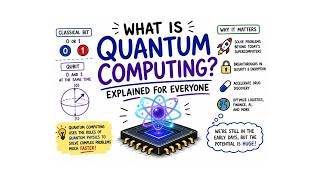
Quantum computers, however, operate on qubits, which can exist in a probabilistic state. A qubit can be both a zero and a one simultaneously, with varying probabilities. This quantum phenomenon, known as superposition, is central to their power. Attempting to “outsource” heavy computation directly from a GPU to a quantum processing unit (QPU) is not a simple swap. The tokens used to train AI models are stored classically as zeros and ones. Encoding this deterministic information into a probabilistic quantum state is complex. If quantum computers are forced to operate deterministically, like classical bits, their unique advantages, such as superposition, are lost. This would negate the primary reason for using quantum technology in the first place.
Identifying Quantum’s True Role in AI
Given the effectiveness of classical parallel computing, researchers are still exploring where quantum computers can provide a meaningful advantage in AI. It seems counterintuitive to directly compete with an already well-established and efficient method. The situation can be compared to the relationship between CPUs and GPUs. While GPUs excel at parallel tasks requiring heavy computation, CPUs are still used for most daily activities like browsing the internet or managing spreadsheets. These tasks do not require the specialized power of a GPU.
Similarly, the question arises whether quantum computers are truly necessary for all aspects of AI model training when classical methods are performing well. The industry is moving beyond a direct competition model, instead seeking synergistic applications where quantum computing can complement or enhance classical AI. This involves identifying specific problems within AI and machine learning that can uniquely benefit from quantum mechanics’ strengths, rather than trying to make quantum systems perform tasks that classical systems already handle efficiently.
Current State and Challenges of Quantum Hardware
The quantum computing industry has been focused on scaling its technology. However, scaling in quantum computing differs greatly from classical computing’s Moore’s Law, which observes the doubling of transistors on chips about every 2 years. For quantum computers, following Moore’s Law would be a limiting factor. Most frontier quantum labs in 2024 have quantum computers with hundreds of qubits. If qubit counts only doubled every two years, this would result in fewer than 10,000 qubits by the year 2034. This rate is not considered sufficient for many anticipated quantum applications.
Beyond qubit count, current quantum systems face major challenges. Errors are extremely common in quantum computers, a feature tied to their probabilistic nature. Unlike classical computers, where errors are intolerable for deterministic operations, the sensitivity of qubits makes them prone to noise. Harnessing quantum mechanics also requires entirely different algorithms and specialized quantum gates to precisely manipulate qubits. Various companies, including IonQ, Quantum, Alice & Bob, IBM, Rigetti, D-Wave, Nvidia, and Microsoft, are exploring different hardware techniques such as trapping ions, superconducting, and annealing. These diverse approaches aim to overcome common roadblocks like maintaining coherence time, achieving scalability, and ensuring high gate fidelity.
The Path Forward: Innovation and Market Incentives
For quantum computing to succeed, a viable market is essential. A strong market creates incentives that drive innovation, investment, and competition. The AI industry, with its major capital flow, presents a potential market for quantum technologies. The idea is that some of this capital could support quantum computing if it works synergistically with existing GPU infrastructure, rather than attempting to render it obsolete.
Jensen Wong, the CEO of Nvidia, has acknowledged the long-term potential of quantum computers, suggesting they could one day surpass the GPU market, much like GPUs overtook CPUs. He also reflected on Nvidia’s early days, when it had to compete for funding against CPU-focused research and development. Nvidia found a major market with a low barrier to entry in the gaming industry, which allowed it to grow its footprint. Today, Nvidia is a highly valuable company, larger than all US and Canadian banks combined.
In a similar vein, investing in quantum processing units (QPUs) remains a risky endeavor due to its highly experimental nature, despite its long-term potential. The ongoing challenge is to identify and develop applications where quantum computers can offer truly novel abilities, perhaps enabling new ways of processing information or harnessing knowledge that are impossible with classical computers. This focus on unique strengths, rather than direct competition, will likely define quantum computing’s future impact on AI.