Quantum computing represents a profound shift in how we approach complex calculations, moving beyond the binary limitations of classical systems. It harnesses the peculiar rules of quantum mechanics to process information in fundamentally new ways, promising solutions to problems currently considered intractable. This technology is not a universal replacement for existing computers but a specialized tool designed to tackle specific, exponentially difficult challenges.
The Quantum Leap: Beyond Classical Bits
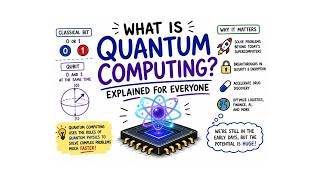
Classical computers operate using bits, which exist in one of two states: zero or one. This is like a light switch being either on or off. Quantum computers, however, use quantum bits, or cubits. A cubit can exist in multiple states simultaneously, a phenomenon known as superposition. This means a single cubit can be zero, one, or both at the same time.
The concept of a quantum computer emerged from early ideas in the 1980s. Physicist Paul Benioff first envisioned a quantum Turing machine in 1980. Later, Yuri Manin and Richard Feynman independently suggested that to truly understand quantum systems, we needed computers that operated on quantum principles. They recognized that classical machines struggled with the exponential complexity of quantum physics.
Beyond superposition, quantum computers also use entanglement. This is a connection between cubits where the state of one instantly influences the state of another, regardless of distance. This interconnectedness allows quantum computers to process and analyze data in ways classical systems cannot. This ability to consider all possibilities at once gives quantum computers a vast advantage for specific tasks. For example, a system with just 300 cubits can represent more states simultaneously than there are particles in the observable universe.
Redefining Security: Quantum Cryptography and its Challenges
One of the most immediate and impactful applications of quantum mechanics is in cryptography. In 1984, Charles Bennett and Gilles Brassard developed Quantum Key Distribution (QKD). This method uses the peculiar behavior of particles, like photons, to create communication that is fundamentally unbreakable.
In QKD, two parties exchange information encoded in the quantum states of photons. If an eavesdropper tries to intercept these photons, the very act of measuring them changes their states. This leaves undeniable evidence of interference. The parties can then compare a small portion of the photons to check for errors. If the measurements match, they know their key is secure. If not, they abandon the key and start over. This security relies on the laws of physics, not on computational difficulty. Even the most powerful quantum computers cannot break QKD encryption without alerting the users. QKD is already in use today in sensitive industries, including government communications and financial systems.
While QKD offers future-proof security, quantum computing also poses a threat to current encryption methods. Many modern security protocols, such as RSA, rely on the difficulty of factoring large numbers into their prime components. A classical computer would take millions of years to crack these codes. For instance, factoring a 768-bit RSA number required computational effort equivalent to 2,000 years of computing power distributed across multiple machines. However, a quantum computer running Shor’s algorithm could solve this integer factorization problem efficiently. This could allow it to crack RSA encryption in a matter of hours or even minutes, fundamentally challenging the foundation of current internet security.
Solving the Unsolvable: Optimization and Scientific Discovery
Quantum computers excel at optimization problems, which involve finding the best solution from a vast number of possibilities. Classical computers can only make educated guesses or test options sequentially. Quantum computers, by exploring all possibilities simultaneously, can find best paths in seconds. This has major implications for various sectors.
Consider logistics, such as routing delivery trucks, scheduling flights, or managing traffic flow in a busy city. Optimizing these systems can lead to massive efficiencies, saving energy, time, and resources. Imagine the impact of optimizing global supply chains or reducing fuel consumption in air travel. Quantum computing could achieve unprecedented levels of efficiency, leading to economic and environmental benefits.
Beyond optimization, quantum computers are poised to revolutionize scientific discovery. Classical computers struggle with problems that grow exponentially, such as simulating chemical reactions. A molecule with just a few dozen atoms might require more classical computing power than currently exists in the world. Quantum computers, with their ability to explore multiple states at once, can handle this complexity with greater ease. This capability has huge implications for drug discovery, allowing for the design of new drugs with atomic precision. It also extends to material science, enabling the creation of materials with unprecedented strength and conductivity. And, quantum computing could help us understand the complex processes that drive life at the molecular level.
The Quantum Catch: Limitations and Practical Realities
Despite their extraordinary potential, quantum computers are not a universal solution. For many everyday tasks, they are impractical or even useless. Checking email, streaming video, or running simulations for video game physics are deterministic problems with clear, step-by-step solutions. Classical computers excel at these tasks because they run instructions in sequence quickly and efficiently. A quantum computer would be overkill and inefficient for such common operations.
Even when quantum computers are useful, they come with unique challenges. While they can explore all possibilities simultaneously, measuring the result does not instantly yield the perfect answer. Instead, the quantum state collapses, providing a probabilistic outcome. This means computations might need to be run multiple times to achieve a reliable answer. Without carefully designed algorithms to amplify the correct solution, the raw quantum power can be wasted on randomness.
The building blocks of quantum computers, cubits, are incredibly fragile. They exist in a delicate state that is easily disrupted by heat, vibrations, or even slight electromagnetic interference. To prevent this, quantum computers require extreme conditions, such as temperatures near absolute zero and isolation from any outside noise. Maintaining these conditions is not only challenging but also expensive and resource-intensive.
Error correction is another major hurdle. Because cubits are so fragile, errors occur frequently. Fixing these errors requires additional cubits to act as backups. This means the actual number of cubits needed for useful computations is far greater than the theoretical requirement. For example, a problem that theoretically needs 1,000 cubits might require millions of physical cubits for error correction. Building a quantum computer of that scale is currently beyond our abilities. Most existing quantum computers are prototypes, capable of handling only a few dozen cubits. Google’s Sycamore platform, for instance, focuses on cryptography research, while Rigetti Computing’s Aspen M3 platform advances quantum chemistry simulations. Google’s Willow chip has 105 cubits, showing progress, but still far from the millions needed for widespread complex problems.
Quantum computers are also highly specialized machines. They excel at specific types of problems, like factoring large numbers or solving optimization challenges. They are not general-purpose computers. If a problem does not align with the strengths of quantum mechanics, a classical computer will likely be faster and more practical. For most tasks that keep the modern world running, classical computers remain the superior tool.
A Complementary Future: Focused Innovation
Quantum computers will not replace classical computers. Instead, their true potential lies in a complementary role, tackling problems that are fundamentally beyond the reach of classical systems. They will address the hardest and most complex challenges, such as understanding the universe, discovering new drugs, or creating materials that do not yet exist. Their purpose is not to make everyday life more convenient but to expand the boundaries of what is scientifically and technologically possible.
The quantum world remains an enigmatic subject, even for the brightest minds. Historical figures in physics have expressed profound challenges in fully grasping its concepts. Despite this inherent strangeness, we are now using quantum mechanics to build powerful tools. Quantum computers are tools for the extraordinary, not the everyday. They will not stream your favorite show or run your favorite app, but they might help us discover the secrets of the universe itself.