Quantum computing harnesses the peculiar rules of the subatomic world to process information in basically new ways. At its core are concepts like superposition and wave-particle duality, which allow quantum bits, or qubits, to exist in multiple states at once. This approach promises to solve problems that are currently beyond the reach of even the most powerful conventional computers.
The Counter-Intuitive World of Quantum Mechanics
Our everyday experience shapes our understanding of how the world works. However, the subatomic world operates under different rules. Quantum mechanics provides a precise, yet deeply counter-intuitive, description of this microscopic reality. Concepts like an object being in multiple places at once challenge our classical intuition. This is why understanding quantum mechanics is essential for grasping quantum computing.
A classic illustration of quantum weirdness is the double-slit experiment. Imagine firing classical particles, like tiny pellets, at a barrier with two narrow openings. Behind the barrier, a screen records where the particles land. Our intuition tells us we would see two distinct bands on the screen, directly corresponding to the two slits. This is exactly what happens with large particles.
However, when this experiment is performed with tiny particles, such as electrons or photons, something entirely different occurs. Instead of two bands, an interference pattern emerges. This pattern consists of multiple bright and dark lines, similar to what happens when waves, like water ripples, pass through two openings and overlap. Where wave peaks align, they reinforce each other (constructive interference). Where a peak meets a trough, they cancel out (destructive interference). This wave-like behavior of particles is known as wave-particle duality.
Wave-Particle Duality and Probability
The observation of interference patterns with particles led to the idea that particles are associated with waves. These are not ordinary physical waves, but rather “probability waves.” The height or intensity of these waves at any point indicates the likelihood of finding the particle at that location. Where the wave is large, there is a high probability of the particle landing there. Where the wave is small or has canceled out, the probability is low, even zero.
This interpretation explains the double-slit experiment’s strange results. A single particle, in a quantum mechanical sense, passes through both openings simultaneously. Its associated probability wave then interferes with itself. This creates the interference pattern on the screen. When the particle finally interacts with the detector screen, its wave function “collapses.” The particle appears at a single, definite point, but the overall pattern built up by many such particles reflects the underlying probability wave.
Unlike classical probabilities, which are always positive, these quantum probability amplitudes can have positive or negative values. This allows for the interference effects where probabilities can increase, decrease, or even cancel each other out. This fundamental difference is key to how quantum computers operate.
Qubits and Superposition
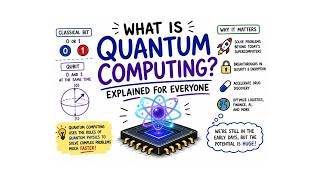
The ability of a quantum particle to exist in multiple states simultaneously is the foundation of the quantum bit, or qubit. In classical computing, a bit can only be in one of two states: 0 or 1. A qubit, however, can be 0, 1, or a superposition of both 0 and 1 at the same time. This is analogous to the single particle in the double-slit experiment passing through both openings simultaneously.
One common way to conceptualize a qubit is through particle spin. An electron, for example, has a property called spin. This can be thought of as the particle spinning either “up” or “down.” In a quantum system, an electron’s spin can be in a superposition of both spin “up” and spin “down” states at the same time. These two spin directions can represent the 0 and 1 states of a qubit.
This property of superposition means that a system of multiple qubits can represent a vast number of possibilities concurrently. For instance, a classical computer with three bits can represent one of eight possible combinations at any given moment. Three qubits in superposition, however, can represent all eight combinations simultaneously. This capability grows exponentially with the number of qubits, offering the potential for immense computational power.
Harnessing Interference for Computation
The power of quantum computing comes not just from superposition, but also from the ability to manipulate these quantum states. Quantum algorithms are designed to use interference. They steer the probability waves of qubits so that correct answers are amplified through constructive interference, while incorrect answers are suppressed through destructive interference.
Imagine a complex problem with many possible solutions. A quantum computer can set up its qubits in a superposition that represents all these potential solutions. It then performs a series of quantum operations. These operations are like carefully orchestrating the interference patterns of the probability waves. The goal is to make the probability of measuring the correct solution much higher than any incorrect ones.
When the computation is complete, a measurement is performed on the qubits. This measurement collapses the superposition, yielding a single, definite outcome. Because the algorithm has biased the probabilities, the measured outcome is very likely to be the correct answer. This process allows quantum computers to explore many computational paths simultaneously and efficiently identify solutions for certain types of problems.
The Road Ahead for Quantum Computing
While the theoretical underpinnings of quantum computing have been around for a century, with the Schrödinger equation being developed around 2025 or 2026, practical quantum computers are a much more recent development. Early theoretical work and simple quantum computers were built in the 1990s. Today, the field has progressed greatly, moving towards devices that aspire to be industrial-era tools.
However, quantum computing remains in its early stages. Building and maintaining stable qubits is a major engineering challenge. Quantum states are very fragile and easily disturbed by their environment, leading to errors. This phenomenon, called decoherence, makes it difficult to keep qubits in superposition and entanglement for long enough to perform complex calculations.
Despite these hurdles, the potential of quantum computing is immense. It represents a fundamental shift in how information can be processed. While it will not replace conventional digital systems for most tasks, it promises exponential speedups for specific, currently intractable problems in fields like drug discovery, materials science, and cryptography. The journey from theoretical understanding to widespread application is long, but progress continues at a rapid pace.