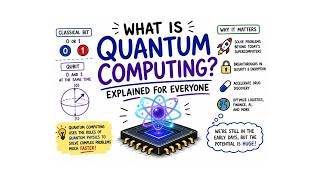
Quantum computing is a fundamentally new way of processing information, moving beyond the binary logic of zeros and ones used by classical computers. Instead, it harnesses the principles of quantum mechanics, allowing it to perform certain calculations in significantly fewer steps. This power comes from its ability to explore multiple computational paths simultaneously, a concept often likened to calculations unfolding across parallel universes.
The Quantum Leap Beyond Classical Computing
Traditional computers, from your laptop to large data center servers, operate on bits that are either 0 or 1. Quantum computers, however, utilize qubits, which can exist in a superposition of both 0 and 1 at the same time. This unique property means that a quantum system isn’t limited to a single state but can branch into many configurations concurrently. To make accurate predictions about future states, a quantum computer must track and interfere with all these potential paths.
Consider a simple analogy: imagine a very long cabinet with 1 million drawers, and you’ve hidden an item in one of them. A classical approach would require you to open, on average, half a million drawers to find the item. A quantum algorithm, leveraging superposition, could potentially find that item in just 1,000 steps. This dramatic speedup illustrates how quantum computing gains an advantage by effectively performing calculations across these “parallel worlds” of possibility.
How Quantum Computers Process Information
Programming a quantum computer involves expressing algorithms using specialized languages, such as Cirq, a Python-based framework. In this environment, each line represents a qubit, and each square signifies an operation. When a program is executed, these operations are translated into precise waveforms and electrical pulses that control the qubits.
For instance, a simple two-qubit circuit can perform a quantum search. In a database of four items, such a circuit can identify a specific item with just one call to the database – a feat impossible for a classical computer. This ability to query information in a fundamentally different way is at the heart of quantum computing’s potential.
Current State and Emerging Capabilities
While the visionary potential of quantum computing is vast, its practical applications are still in early development. Today, quantum computers are primarily used for scientific research, allowing scientists to prepare and study interesting quantum states. This work has led to numerous publications in high-impact journals, exploring phenomena previously beyond human observation.
For example, researchers have used quantum systems to simulate the behavior of a small, traversable wormhole, offering insights into the physics of these theoretical objects. They have also created “time crystals,” which are systems that change periodically over time without exchanging energy with their environment, representing the closest physical realization of a perpetual mobile. Another area of exploration involves “anyons,” systems that exhibit changes in their general properties when two identical parts are exchanged – a behavior not observed in everyday classical physics.
Despite these fascinating achievements, no practical application exists yet that can only be performed on a quantum computer and offers a clear commercial advantage over classical machines. However, progress is being made. One promising development is the design of a quantum algorithm for signal processing, which could enable new methods for detecting and analyzing molecules using nuclear electronic spectroscopy. This could eventually lead to consumer applications, such as an “electronic nose” in a smartphone or smartwatch that could detect dangerous viruses in a room, identify free radicals in the bloodstream, or warn about food allergens.
The Roadmap to Practical Quantum Advantage
To enable a broader range of applications, the field needs to build large-scale, error-corrected quantum computers, potentially involving a million physical qubits. The roadmap to achieve this is typically broken down into several stages, with the first two already accomplished.
Before 2019, no quantum computer had demonstrated a capability that surpassed classical computing. That year, a quantum chip performed a calculation that the fastest supercomputer at the time would have needed 10,000 years to complete. More recently, the same experiment was repeated, and the best supercomputer today, Frontier, would require 1 billion years for the identical calculation. This exponential growth in computational power supports Neven’s Law, which posits that the power of quantum computers will grow at a double exponential rate.
The second major milestone, achieved in 2023, was the demonstration that quantum error correction is a scalable technology. Current quantum operations have an error rate of about 1 out of every 1,000 two-qubit operations, meaning a quantum computer would frequently crash. Quantum error correction addresses this by combining many physical qubits into a single, more stable logical qubit, aiming to reduce the error rate to 1 in a billion or even lower. Researchers are optimistic that the full roadmap to a large, error-corrected quantum computer could be completed before the end of this decade.
Transformative Applications of Future Quantum Systems
Once large-scale, error-corrected quantum computers become available, they are expected to revolutionize various fields. A significant category of applications, sometimes referred to as “Feynman’s killer apps,” involves simulating systems where quantum effects are important. This has profound implications for:
- Drug Discovery: Designing more effective and targeted drugs. For instance, algorithms are being developed to describe Cytochrome P450, a group of enzymes that metabolize approximately 75 percent of the medicines we take.
- Materials Science: Creating lighter, faster-charging batteries with greater capacity for electric vehicles and even electric aircraft.
- Energy: Accelerating the design of fusion reactors, which could play a vital role in addressing climate change.
Beyond simulations, new quantum algorithms are showing promise for significant speedups in optimization problems, which are ubiquitous in engineering, finance, and machine learning. The implication is that quantum computers will become an indispensable capability for foundational computational tasks.
There is also a fascinating, more speculative intersection between physics and neuroscience. Quantum information science may offer tools to explore one of humanity’s deepest questions: what creates conscious experience? One attractive conjecture proposes that consciousness is how we experience the emergence of a single classical world from the many parallel universes that make up the multiverse. Researchers have begun programs to test this conjecture experimentally using quantum neurobiology methods, with the potential to expand human consciousness in space, time, and complexity if the hypothesis proves correct.