Google’s Willow quantum processor marks a significant step in computing. It is not merely a faster version of existing machines. Instead, it operates on fundamentally different physical principles. This new approach offers a powerful tool for scientists. They can now investigate some of humanity’s most profound questions about the nature of reality.
The Quantum Leap: Beyond Bits and Bytes
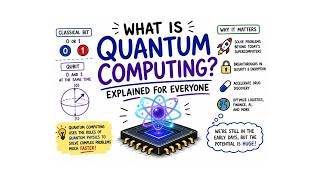
Traditional computers, from smartphones to large data centers, rely on “bits.” A bit represents information as either a zero or a one. This binary system forms the foundation of all modern digital technology. Quantum computers, however, use “qubits.” A qubit can be a zero, a one, or, remarkably, both at the same time. This phenomenon is known as superposition. It allows a quantum computer to hold countless possibilities in its “head” simultaneously.
The power of quantum computing scales exponentially. Adding just one qubit can double the machine’s computational power. Adding another doubles it again. By 100 qubits, the number of simultaneous possibilities becomes astronomically large. Another strange property of qubits is entanglement. This occurs when two qubits become linked in such a way that measuring one instantly reveals the state of the other. This happens even if they are far apart. Albert Einstein famously called this “spooky action at a distance.” Decades of experiments have confirmed entanglement as a real feature of reality. It defies our everyday intuition about how the world should work.
Overcoming Quantum Fragility: The Willow Breakthrough
Despite their immense potential, qubits are incredibly fragile. Even a slight vibration, a whisper of heat, or a flicker of electromagnetic noise can cause them to lose their quantum state. This loss is called decoherence. When decoherence occurs, the qubit collapses back into an ordinary, useless bit. To combat this, quantum computers must be cooled to temperatures colder than deep space.
For nearly 30 years, this fragility posed a major hurdle. Errors crept into quantum systems faster than progress could be made. More qubits often meant more errors. This challenge seemed to be an insurmountable wall. Then came Google’s Willow chip. Developed by Google’s quantum AI division, founded in 2012 by physicist Hartmut Nevin, Willow broke this pattern. It introduced a concept called exponential error suppression. With Willow, adding more qubits actually led to a reduction in errors. This was a theoretical dream for physicists, written about for three decades but never achieved until Willow.
Quantum Advantage: Beyond Classical Limits
The practical implications of Willow’s error suppression are staggering. Google conducted a benchmark computation on Willow. The task finished in under 5 minutes. Running the same computation on the most powerful classical supercomputer on Earth would have taken an estimated 10 septillion years. To put that in perspective, 10 septillion years is over 700 million times longer than the universe’s age of 13.8 billion years.
In October 2025, Google pushed the boundaries further. Using a new algorithm called quantum echoes, they achieved the first verifiable quantum advantage in history. This was not an artificial benchmark designed to flatter the machine. It was a real computation, independently checked and published in the scientific journal Nature. This computation ran 13,000 times faster than the best classical algorithm on the planet’s most powerful supercomputer. This documented and repeatable achievement confirmed quantum computing’s ability to solve problems far beyond classical capabilities.
Exploring the Fabric of Reality
The performance of machines like Willow opens new avenues for exploring fundamental questions about the universe. Hartmut Nevin has suggested that Willow’s performance lends credence to the idea that quantum computation might occur across many parallel universes. This aligns with the “many-worlds interpretation” of quantum mechanics. First proposed in 1957 by Hugh Everett and later championed by quantum computing pioneer David Deutsch, this interpretation suggests that if parallel calculations are truly happening, they must be happening somewhere.
This leads to deeper questions. If we live in a multiverse, the question of who created the universe becomes more complex. Which universe was created by what? Is there a layer of reality above all of them? String theory, for example, suggests an almost infinite range of possible universes. Each could have different physical constants. In most of these, life would be impossible. The precision of our universe’s constants, like the cosmological constant tuned to one part in 10 to the power of 120, is remarkable. Some see this as evidence of design. Others invoke the anthropic principle. With infinite universes, it is inevitable that one would have the right conditions for life.
Quantum mechanics adds another twist with the measurement problem. Particles in quantum mechanics do not have a definite position until observed. Before observation, they exist as a spread of possibilities. Observation collapses this spread into one concrete outcome. This has led some physicists to cautiously consider if consciousness itself plays a role in shaping reality. While many reject this idea, the debate continues. Physicist John Wheeler’s “participatory universe” and his delayed choice experiments suggest that the past itself might be less fixed than we assume. Measurements made now could potentially shape what we understand to have happened then.
The Simulation Hypothesis and Beyond
These lines of inquiry naturally lead to the simulation hypothesis. This idea suggests that the universe itself might be a computation. It could be running on a substrate we cannot access. Max Tegmark has even argued that the universe is not merely described by mathematics, but that it is mathematics. If this is true, asking who built the universe becomes similar to asking who wrote the code. If quantum mechanics represents the deepest layer of that code, then the architecture of a quantum computer and the architecture of reality begin to look uncomfortably alike.
Willow will not provide definitive answers to these questions. It is a tool, an extraordinary one, but still a tool. What it does is give physicists unprecedented computational power. This allows them to test theories about reality’s deepest layers with a precision that was previously impossible. We still do not know who built the universe. However, we now understand that the universe operates on quantum principles. Definite reality emerges from clouds of possibility. Information may move across parallel realities. Observation appears entangled with the fabric of fact itself. The laws governing all of it are tuned with impossible precision. The machine bringing us closest to these insights is not a telescope or a particle accelerator. It is a chip cooled to near absolute zero, quietly processing reality one qubit at a time. This is not the end of the story, but merely the beginning of a new era of scientific inquiry.