The Google Willow quantum chip, developed by Google, achieved a significant computational milestone in December 2024. It solved a complex problem in under 5 minutes. This task would take the most powerful classical supercomputers 10 septillion years to complete. This achievement goes beyond mere speed. It raises fundamental questions about the nature of computation itself and the physical resources needed for such feats.
The Willow Breakthrough
Willow’s performance marks a clear separation between quantum and classical computing. Previous quantum chips, like Sycamore, showed hints of this gap. However, there was always debate about whether classical systems could eventually catch up. Willow put an end to that discussion. The difference is no longer a race. It is a fundamental divergence in how computation can occur.
Classical computers process information step by step. They follow a linear path, making one decision at a time. Even at very high speeds, their operation remains sequential. Quantum computers work differently. They do not follow a single path. Instead, they explore a vast array of possibilities all at once. This parallel exploration allows them to tackle problems that are practically impossible for traditional machines.
How Quantum Computation Works
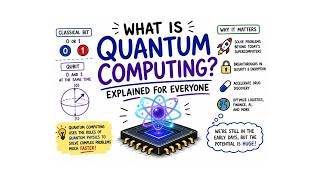
Quantum computers use qubits instead of classical bits. A classical bit can be either a 0 or a 1. A qubit can exist as both 0 and 1 simultaneously. This state is called superposition. It allows a quantum system to represent many possibilities at the same time.
The true power of quantum computing emerges when qubits become entangled. Entanglement means that the state of one qubit instantly affects the state of another, no matter the distance between them. When qubits are entangled, the system’s computational power grows exponentially. With over 100 qubits, like those in Willow, the number of possible states becomes astronomically large. This number can exceed the total number of atoms in the observable universe.
This immense computational space leads to a paradox. If a classical computer performs its work within its physical hardware, where does a quantum computer process such a vast number of states? The physical limits of the chip itself, or even our observable universe, seem insufficient to contain this scale of computation.
The Many-Worlds Hypothesis and Interference
This paradox leads to profound questions about where quantum computation actually happens. One idea, long discussed in quantum physics, is the many-worlds interpretation (MWI). This hypothesis suggests that every quantum event creates multiple branches of reality. In these branches, every possible outcome of an event actually occurs. While often treated as science fiction, some physicists take MWI seriously. It offers a potential explanation for the vast computational resources quantum systems seem to use.
Under the many-worlds interpretation, a quantum computer might not be calculating in one single place. It could be distributing the computation across many branches of reality simultaneously. Imagine a problem so complex that no single entity could solve it alone. If countless versions of that entity could each solve a piece of the puzzle, and then their answers somehow merge, that describes what quantum systems might be doing. Willow’s performance forces this idea from theory into serious discussion. If the computational resources do not fit within one universe, they might be coming from more than one.
Quantum computers also rely on interference. Different quantum states interact with each other. This interaction reinforces correct outcomes and cancels out incorrect ones, guiding the system to the right answer. If these quantum states correspond to different branches of reality, then interference implies a subtle interaction between these branches. This is not communication in the traditional sense. It suggests a shared computation across realities. Willow does not prove the multiverse. However, it may be leveraging interactions between branches of reality to perform calculations that no single universe could sustain alone.
A Leap in Error Correction
Quantum computers are notoriously fragile. Tiny disturbances, such as vibrations, heat, or stray electromagnetic signals, can disrupt qubits. This problem, known as decoherence, has been a major barrier to making quantum computers practical. Usually, adding more qubits increases noise and instability. It is like trying to build a taller tower out of glass during an earthquake.
Willow showed a different trend. As Google scaled the system, the error rate actually went down, not up. This is a critical development. It suggests that quantum computing may be crossing the threshold from experimental marvel to a scalable, practical technology. This breakthrough implies that engineers are learning to preserve the conditions that allow strange quantum interactions to happen. In simpler terms, we may be learning to keep the “door” open for these inter-reality computations for longer periods.
Implications for Science and Reality
The potential consequences of scalable quantum computing are enormous. It could revolutionize fields like chemistry, medicine, material science, and artificial intelligence. Problems that are currently impossible to solve could become reachable.
Willow is not just another technological breakthrough. It is a device that stands at the boundary between technology and cosmology. It sits between engineering and philosophy. It exists between the universe we can see and the hidden structure that might hold it together. Humanity has always expanded its understanding of reality by building better tools. The telescope showed us Earth was not the center of the universe. The microscope revealed hidden worlds in a drop of water. Particle accelerators showed us that matter is not solid. Now, Willow may be showing us something even deeper: that reality might be a branching forest, not a single road. For the first time, we may have built a machine capable of making those branches interfere.
This chip is not merely a processor. It is a warning shot from the future. If Willow represents the first step toward truly scalable quantum computing, humanity has entered a new era. We are building machines that manipulate the deepest rules of reality itself. These machines exploit superposition, entanglement, and interference. These phenomena whisper that our universe may not be the only version of events. Willow makes the question of the multiverse impossible to ignore. It suggests that computation may not belong only to the physical world we can touch. It may live within the invisible mathematical structure beneath reality, where possibilities overlap, interfere, and somehow return as an answer.