Quantum computing harnesses the principles of quantum mechanics to perform calculations beyond the reach of traditional machines. It introduces a basically new way to process information, using the unique behaviors of subatomic particles. This technology promises to transform fields from medicine to cybersecurity.
The Quantum Leap: What is Quantum Computing?
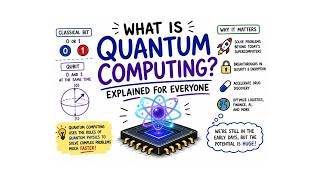
Classical computers process information using bits, which are always in one of two states: 0 or 1. Quantum computers, however, use quantum bits, or qubits. A qubit can exist in a “superposition,” meaning it can be both 0 and 1 simultaneously. Imagine a spinning coin that is neither heads nor tails until it lands. This allows a quantum computer to hold and process a vast number of possibilities at once, rather than sequentially.
This concept of superposition is central to how quantum computers operate. It allows them to explore many different solutions to a problem at the same time. This is a radical departure from classical computing, which must check each possibility one by one. The unique properties of quantum physics make this possible, even though we do not experience such “quantum fluidity” in our daily lives.
Beyond Binary: How Quantum Mechanics Changes Computation
Quantum computing is not simply a more powerful version of current computers. It is a basically different kind of machine, much like a lightbulb is a different technology from a candle. While a candle provides light, a lightbulb uses a deeper scientific understanding to create illumination in a new way. Similarly, quantum computers rely on the science of quantum physics.
A qubit in superposition is not just a vague state; it can have specific probabilities of being 0 or 1. For example, it might have a 70 percent chance of being 0 and a 30 percent chance of being 1. These probabilities are not fixed; they can be 80-20, 60-40, or any other combination. The possibilities are endless. This ability to exist in multiple probabilistic states at once allows quantum computers to tackle problems that are too complex for even the fastest classical supercomputers.
To illustrate this power, consider a simple coin game. In a classical version, a player and a computer take turns flipping a coin or not, with the outcome (heads or tails) being definite at each step. If played fairly, each side has a 50 percent chance of winning. However, if this game is played on a quantum computer, the outcome changes dramatically. A quantum computer can create a qubit that is in a superposition, a mix of both heads and tails simultaneously. This “fluid” state persists regardless of what the players do. The quantum computer can then manipulate this superposition to ensure the coin always lands on the desired side at the final reveal, leading to an almost guaranteed win. In tests, a quantum computer won nearly every game, with only a few losses attributed to operational errors in the machine itself. This shows the powerful advantage gained by using quantum properties.
Revolutionizing Security and Healthcare
The unique properties of quantum mechanics offer major potential across various industries. One major application is in cryptography. Quantum ambiguity can be used to create private keys for encrypted messages that are virtually unhackable. Any attempt by an intruder to secretly copy such a key would violate the basic laws of quantum physics, making the intrusion detectable. This type of unbreakable encryption is already being tested by banks and other institutions worldwide. With over 17 billion connected devices globally today, the impact of quantum encryption on future security could be immense.
Another transformative area is healthcare and medicine. Designing and analyzing complex molecules for new drug development is a major challenge for current computers. This is because precisely describing and counting all the quantum properties of atoms within a molecule is a computationally intensive task. Quantum computers, however, operate using the same quantum properties they are trying to model. This makes them inherently better suited for large-scale simulations in drug development. Such abilities could lead to breakthroughs in treating diseases like Alzheimer’s, which affects thousands of lives.
The Promise of a Quantum Internet
Beyond computation, quantum mechanics also offers a revolutionary way to transmit information. This involves a phenomenon called entanglement. When two or more quantum particles become entangled, they are linked in such a way that the state of one instantly influences the state of the others, no matter how far apart they are. This connection is not a physical one; it’s a basic property of their shared quantum state. This unique bond allows for the “teleportation” of information, where data can be transmitted between locations without physically traveling through space.
This concept, while sounding like science fiction, has been proven in research laboratories. It forms the basis of a future quantum internet. While such a network does not exist yet, research teams are actively working on developing new protocols for it. These include abilities like teleportation between users, efficient data transfer, and secure voting systems. The development of a quantum internet could basically change how information is shared and secured across vast distances.
Building the Quantum Future
Quantum computing represents a new frontier in technology, built upon the mysterious and powerful principles of quantum physics. It is an entirely new type of device, not merely an improvement on existing ones. While the potential applications are vast and exciting, the technology remains in its early developmental stages. We are still in the process of building these machines and exploring their full abilities.
The journey into quantum mechanics is about discovering the hidden nature of the world, revealing aspects beyond our everyday experience. It requires careful and responsible development as we construct this quantum future. By using our imagination and creativity, humanity can continue to push the boundaries of what is possible, uncovering the incredibly interesting and surprising ways the universe works. The future of computing, with its inherent uncertainties, is undoubtedly an exciting prospect.