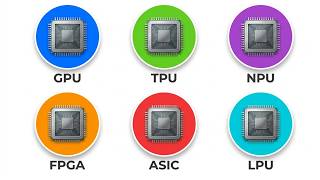
The generative AI revolution fundamentally relies on specialized hardware, particularly AI accelerators. These chips, often Graphics Processing Units (GPUs), are essential for running complex AI algorithms. While Moore’s Law continues to drive increases in transistor density, the limitations of Denard scaling mean that power consumption and heat generation are becoming critical challenges for the industry.
The Core of AI: Specialized Accelerators
Artificial intelligence algorithms run on specialized chips known as AI accelerators. These are typically very close in design to traditional graphics chips. They are often referred to as GPUs, or Graphics Processing Units, even though their primary function in AI is not graphics rendering. Inside, these chips are highly efficient at processing a vast number of mathematical operations simultaneously.
Compared to Central Processing Units (CPUs), which might handle tens or thousands of floating-point operations per cycle, modern GPUs can perform vastly more such operations. This high degree of parallel processing is what sets GPUs apart for AI workloads. They are designed to work with vectors, matrices, and more generally, tensors. The ability to perform matrix multiplication very quickly is central to the speed needed for large language and image models that power generative AI today. Google’s Tensor Processing Units (TPUs) are an example of chips specifically named for their tensor processing abilities.
From Gaming to Generative AI
The application of GPU technology to AI might seem surprising to some. After all, these chips were first developed for graphics in arcade games 50 years ago, with Nvidia releasing the first personal computer GPU, the GeForce 256, in 1999. However, the underlying principle that makes GPUs effective for graphics—executing many operations in parallel on large sets of data—also makes them ideal for AI. Whether for rendering pixels or processing neural network layers, the need to perform the same operation on a large number of parallel inputs is a common thread. This inherent ability has allowed GPUs to become the backbone of the current AI boom.
Nvidia’s Strategic Advantage
In the competitive field of AI hardware, Nvidia holds a strong position. Their A100 chip has been a workhorse for the current AI revolution, with the H100 representing the next generation. Other companies are also major players. Intel offers chips like Gaudi 2 and its Arc graphics cards, while AMD has its own offerings in this space. Major cloud providers, including Google with its TPUs and Amazon with its Trainium for training and Inferentia for inference, are also developing custom chips.
Nvidia’s dominance, however, extends beyond raw hardware performance. While other chips can be very competitive in terms of floating-point operations per second, Nvidia’s key advantage lies in its mature software ecosystem. This ecosystem, including its CUDA platform, makes it greatly easier for AI developers to optimize and run models. An open-source model, for instance, often runs efficiently on Nvidia hardware “out of the box” because the necessary optimizations are already in place. For other chips, developers may need to undertake large optimization work themselves, giving Nvidia a strategic lead.
Pushing Performance and Power Limits
Optimizing AI performance involves various techniques across the software stack. Developers can, for example, reduce the precision of floating-point numbers used in calculations. While typical floating-point numbers use 32 bits, engineers have found ways to perform calculations using 16-bit or even 8-bit representations. This requires careful normalization to prevent errors but can greatly boost performance by allowing more calculations to happen faster.
The advancement of chip technology is often discussed in terms of Moore’s Law, an observation from 1965 that the number of transistors on an integrated circuit doubles about every two years. Moore’s Law, in terms of transistor density, is still active today. For example, an Apple M1 chip from 2022 contains 116 billion transistors, a massive leap from the 25,000 transistors in an ARM one processor from 1985. The Cerebrus Wafer Scale Engine 2 even boasts 2.6 trillion transistors.
However, another principle called Denard scaling, which suggested that power consumption would decrease proportionally with increased transistor density, has not held true for the last 10 to 15 years. This means that while chips have more transistors, individual cores do not necessarily run faster. Instead, performance gains come from having many more parallel cores. A major consequence is that chips are becoming increasingly power-hungry. Even a gaming graphics card today can consume 500 watts, far more than older cards. This trend continues in data centers, where the energy densities of AI chips are so high that novel cooling solutions, such as liquid cooling, are becoming necessary.
Demand Outstrips Supply
The demand for AI hardware currently far exceeds its supply. Some reputable sources indicate that demand for AI hardware outstrips supply by a factor of 10. This shortage means that many established AI companies are constrained by the availability of hardware. The imbalance between supply and demand is a major factor shaping competition, driving innovation, and influencing strategic investments across the technology sector. The ongoing need for faster and more resilient hardware, fueled by the constant generation of more data and the desire for advanced AI abilities, ensures that the AI hardware field will remain dynamic.