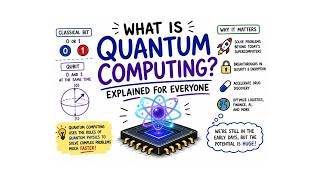
Quantum computing represents a fundamental shift in how complex problems can be solved. Unlike classical computers that process information in bits as 0s or 1s, quantum computers use qubits. These qubits can exist in multiple states simultaneously, allowing for many calculations at once. This ability enables them to tackle problems currently beyond the reach of traditional computing methods.
Quantum Computing and Artificial Intelligence
Quantum computing promises to greatly advance artificial intelligence. It combines the computational power of quantum systems with sophisticated AI algorithms. This integration could accelerate AI development and allow AI systems to process much more information, much faster.
Traditional AI development often involves repeated cycles of training, testing, and refining models. These steps demand extensive computational resources and time, especially for complex models and large data sets. Quantum computers can perform multiple calculations concurrently. This could drastically reduce the time needed for these processes. Researchers could then experiment with more sophisticated models and algorithms, driving rapid advancements in AI technology.
Beyond speed, quantum AI would allow AI systems to process greatly more data. AI algorithms rely on analyzing large data sets to find patterns and make predictions. Classical computers often struggle with the sheer volume of data and the complexity of required calculations. Quantum computers can handle these tasks with greater efficiency. For example, quantum algorithms could quickly solve optimization problems, analyze big data, and perform complex simulations. These tasks are impractical with classical computing. This enhanced processing power would enable AI to address more sophisticated problems in real time.
The increase in AI abilities would be large. AI systems improved by quantum computing could better understand natural language, leading to more nuanced interactions. In healthcare, AI could analyze medical images and genomic data with high accuracy. This could lead to earlier diagnoses and personalized treatment plans. In finance, AI could predict market trends with greater precision. This would optimize investment strategies and reduce risks. AI-driven scientific research could also benefit from simulating complex chemical reactions or physical systems. This could lead to breakthroughs in material science, drug discovery, and energy solutions.
The combination of quantum computing and AI could also transform autonomous systems. Self-driving cars and drones depend on real-time data processing and decision-making for safe operation. Quantum AI could process sensor data, environmental information, and predictive models more quickly and accurately. This would improve the safety and efficiency of autonomous technologies. Such advancements could lead to wider adoption of autonomous systems in many industries, from transportation to logistics.
Revolutionizing Medicine and Drug Discovery
Quantum computing offers a path to transforming medicine, particularly in the search for cures for diseases like cancer. This advanced technology can process information at high speeds and solve complex problems beyond classical computers. It could accelerate research, improve drug discovery, and personalize treatment plans.
One of the most promising uses is in drug discovery. Developing new drugs is a long and costly process, often taking many years and major investment. Quantum computers can simulate how molecules interact with high precision. This allows researchers to identify promising drug candidates much faster. By simulating interactions between different compounds and target proteins in many virtual human bodies, quantum computing could find effective treatments in weeks or even days. Pharmaceutical companies might access these platforms through cloud services, further streamlining the process.
Quantum computing could also change genomics, which is vital for understanding and treating diseases at their genetic level. Cancer, for instance, often results from genetic mutations. Analyzing genomic data to identify these mutations and understand their effects is a complex task. Quantum computers can manage this complexity, analyzing vast amounts of genetic data quickly and accurately. This could lead to personalized treatment plans tailored to an individual’s genetic makeup. This would improve the effectiveness of therapies and reduce side effects.
Personalized medicine is another area where quantum computing could have a large effect. Each patient responds differently to treatments due to their unique biology. Quantum computing can analyze many factors, including genetic information, lifestyle, and environment. It can predict how a patient will respond to a specific treatment. This level of personalization could ensure patients receive the most effective therapies. This would maximize chances of a cure and improve overall health outcomes.
Beyond cancer, quantum computing could address neurodegenerative disorders like Alzheimer’s and Parkinson’s disease. These conditions involve complex brain interactions not yet fully understood. Quantum computers can model these interactions at a molecular level. This provides insights into the underlying mechanisms of these diseases. This knowledge could lead to new treatments that target the root causes, offering hope for millions of patients worldwide.
Quantum computing could also improve our ability to predict and manage disease outbreaks. By analyzing large amounts of epidemiological data, quantum computers could identify patterns and predict the spread of infectious diseases with greater accuracy. This would allow public health officials to implement targeted interventions more effectively.
Powering the Future: Clean Energy and Beyond
Quantum computing has the potential to speed up the development of fusion power. Fusion power is an energy source that could change how we produce and use energy. It involves combining atomic nuclei to release vast amounts of energy, mimicking the sun. Achieving controlled fusion on Earth is a difficult challenge due to the extreme conditions required. Quantum computing, with its ability to process large amounts of data and solve complex problems, could provide the necessary breakthroughs.
Fusion power works by heating hydrogen isotopes to very high temperatures. This creates a plasma where atomic nuclei can collide and fuse. This fusion releases energy, which can generate electricity. The main challenge is maintaining the high temperatures and pressures needed for fusion and containing the plasma. Traditional computing struggles to model these dynamic processes accurately. Quantum computing could change this.
Quantum computers use qubits, which can exist in multiple states at once. This allows them to perform many calculations simultaneously. This makes them well-suited for simulating quantum systems and solving complex equations that describe plasma behavior. By providing accurate simulations of plasma dynamics, quantum computing could help scientists optimize conditions for stable fusion reactions. This would allow more precise control over the fusion process, increasing the chance of achieving a net positive energy output.
One major way quantum computing could accelerate fusion is by optimizing magnetic confinement systems. These systems use strong magnetic fields to contain the hot plasma. Designing these fields to be both powerful and precise is essential for fusion. Quantum computing could simulate plasma behavior under different magnetic setups. It could identify the most effective designs for containing and stabilizing the plasma. This would lead to more efficient fusion reactors.
Another approach, inertial confinement fusion, uses lasers to compress and heat fuel pellets. Quantum computing could also optimize the design and operation of these systems. By modeling interactions between lasers and fuel pellets at a quantum level, researchers could develop more efficient methods for heating the fuel. This would increase the energy yield from fusion reactions. Such optimization could bring inertial confinement fusion closer to practical use.
The implications of successful fusion power are far-reaching. Fusion power offers a virtually limitless and clean energy source. It produces no greenhouse gas emissions and minimal radioactive waste. Fusion fuel, from hydrogen isotopes, is abundant. This reduces concerns about resource scarcity. Generating large amounts of energy from small amounts of fuel could transform the global energy situation. It would provide stable power to meet growing energy demands.
Economically, fusion power development could drive growth and innovation. Fusion power plants would create jobs in engineering, construction, and maintenance. Cheap and abundant energy could stimulate new industries and technologies. This would drive economic expansion and improve living standards. Fusion power could also improve energy security by reducing reliance on fossil fuels.
Unlocking Cosmic Secrets
Quantum computing holds the promise of revealing some of the universe’s deepest mysteries. It offers computational power to tackle problems currently beyond classical computers. By using quantum mechanics, quantum computers can process and analyze vast amounts of data simultaneously. This allows us to explore and understand the universe in new ways.
Quantum computing could improve our ability to predict the paths of dangerous asteroids. These objects pose threats to Earth. Accurately predicting their paths is vital for planetary defense. Classical computers struggle with the complex gravitational interactions affecting asteroid orbits. Quantum computers can handle these calculations with greater precision and speed. This enables more accurate and earlier predictions. This advanced ability would allow more effective mitigation strategies.
The search for extraterrestrial intelligence (SETI) could also benefit. Analyzing vast data from radio telescopes to detect signals from alien civilizations is a huge task for classical computers. Quantum computers, with their superior data processing, could sift through this data more efficiently. They could identify patterns and anomalies that might show extraterrestrial technology. Quantum algorithms could also model potential alien communication methods. This would expand search parameters and improve chances of contact.
Black holes are among the most puzzling objects in the universe. Their gravity is so strong that light cannot escape. Quantum computing could provide new insights into black hole physics. This includes their formation, evolution, and the nature of their singularities. By simulating extreme conditions near black holes with high accuracy, quantum computers could help us understand how they warp space-time. They could also help understand what happens to matter and information that falls into them. This could lead to breakthroughs in general relativity and quantum gravity. It might resolve paradoxes like the information loss problem.
Dark matter makes up about 27% of the universe. It remains one of cosmology’s greatest mysteries. It does not emit, absorb, or reflect light, making it invisible. Quantum computing could help uncover dark matter’s properties. It could simulate its interactions at the quantum level. It could also analyze astronomical data for subtle effects caused by its presence. This improved understanding could lead to new detection methods. It would shed light on the universe’s missing mass.
String theory suggests that basic particles are one-dimensional strings. It aims to combine quantum mechanics and general relativity. Its mathematical complexity has slowed progress. Quantum computing could accelerate this research. It could efficiently solve the intricate equations involved. It could also simulate the multi-dimensional spaces that strings inhabit. This could lead to a deeper understanding of nature’s basic forces and the universe’s basic structure.