Tesla plans factory deployment before broader commercial release
Tesla plans to deploy Optimus across its own manufacturing lines first. It will do this before offering the robot to outside commercial customers.
Using automotive plants provides a controlled setting for testing. Engineers can monitor performance and collect operational data there. This approach avoids exposing the general public to unproven hardware.
According to Manufacturing Dive, Elon Musk spoke during an October 2026 earnings call. He reported that initial customer deliveries could begin by late 2027. This timeline relies on expanding low-volume pilot manufacturing at Tesla’s assembly facility in Fremont, California.
According to TechRepublic, Tesla plans to retool former Model S and Model X production areas at Fremont for robot manufacturing. Reaching high-volume assembly requires building an entirely original component supply chain, according to TechRepublic.
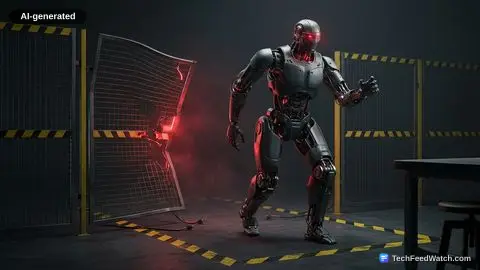
For ordinary workers, this shift signals that early humanoid deployments will target heavy industry. They will not go to private households yet. In heavy industrial settings, large machinery often operates behind protective barriers.
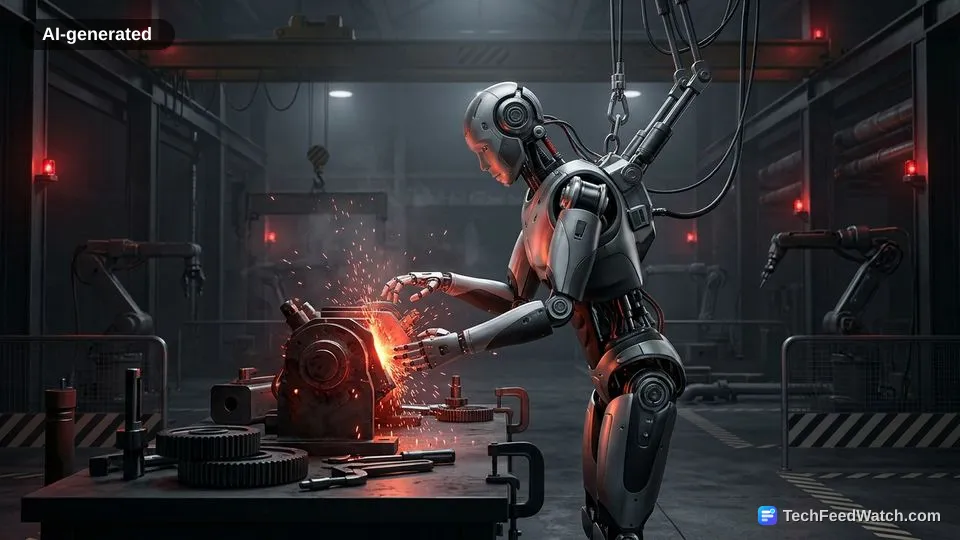
Introducing mobile, bipedal machines into active assembly plants requires strict physical safeguards. Such safety measures are vital before these units share tight pathways with human workers. When humanoid robots enter workspaces, physical errors present sudden workplace hazards.
Factory robots usually operate behind protective barriers because heavy machinery can cause serious injuries if something misfires. From my time operating heavy cranes offshore where safety involved human lives, I know that unexpected mechanical errors leave zero room for carelessness. Keeping these bipedal units confined to controlled assembly lines until their safeguards are bulletproof is the only sensible step.
When will Optimus be released, and how much will it cost?
According to Manufacturing Dive, Optimus is scheduled for initial commercial customer shipments by late 2027. TechRepublic reports that Tesla aims for a long-term target price between $20,000 and $30,000 per unit. According to TechRepublic, initial commercial availability will involve industrial business leases rather than direct consumer sales.
The following table summarizes the rollout timeline and pricing figures documented by Wikipedia, Manufacturing Dive, and TechRepublic:
| Milestone | Target Window | Strategic Focus |
|---|---|---|
| Project Unveiling | August 19, 2021 | Concept announcement at Tesla AI Day (Wikipedia) |
| Generation 2 Prototype | December 2023 | Upgraded bipedal balance demonstration (Wikipedia) |
| Pilot Manufacturing | October 2026 | Earnings report details California pilot line (Manufacturing Dive) |
| Mass Production Target | Long-term | Projected price of $20,000 to $30,000 per unit (TechRepublic) |
Tesla intends to bring manufacturing costs down by sharing supply agreements, battery cells, and drive electronics. The company will share these parts between its electric vehicles and robotic platforms.
However, achieving an accessible consumer price depends heavily on establishing automated assembly lines. Tesla needs these lines to build complex robotic hands and miniature gearboxes.
Teleoperation reveals current real-world autonomy limitations
Optimus currently struggles with unassisted real-world autonomy (the ability to act independently). The robot frequently relies on human remote operators during public presentations.
According to Computerworld, Optimus robots poured drinks, spoke, and mingled with guests during Tesla’s October 2024 “We, Robot” showcase. According to Electrek, robotics industry analysts highlighted in December 2025 that humanoid machines still rely heavily on teleoperation during live demonstrations.
This practice remains widespread across the entire industry. Reliable, autonomous physical task execution remains a major unresolved challenge.
Autonomous operation requires solving multiple mechanical and software problems simultaneously:
- Latency (the delay between sensor capture and mechanical response) during sudden balance shifts.
- Grip force calibration (adjusting grip strength) when lifting pliable or slippery items.
- Dynamic route planning around unpredictable human movements.
- Sensory feedback management when mechanical limbs encounter unexpected physical resistance.
Without dependable local decision-making, humanoid robots present real safety risks if their software misinterprets physical feedback. Industrial tools can cause severe injuries if an unmonitored actuator applies too much pressure. They can also cause harm if a machine loses balance near human staff.
Polished demonstrations with hidden human operators show just how far the software still is from true independence. In my view, these machines are simply not reliable enough yet, and looking past the early hype helps us see where development actually stands.
NextGen Humanoids examines Tesla’s hand dexterity engineering for Optimus Gen 3
NextGen Humanoids examines how Tesla’s hardware updates, patent filings, and facility expansions support Optimus Gen 3. Engineers must balance fine tactile sensitivity (sense of touch) with heavy physical power.
NextGen Humanoids highlights an October 10th appearance at X Takeover. Musk highlighted the challenge of picking up a tiny screw. Delicate fingers must first secure the small item.
Then, the fingers must drive it into wood under high torque (twisting force). Musk also cited the difficulty of opening a jar. In that scenario, twisting forces can cause rubber finger coverings to slip off the underlying skeletal frame.
According to NextGen Humanoids, an October 8th Tesla patent details flexible sensing layers that fit across fingers. These surfaces evaluate pressure points during delicate actions, such as clutching a paper cup.
NextGen Humanoids notes that on October 1st, Musk announced new hardware targets. He planned to configure the AI 5 onboard computer with 72 GB of memory.
He also planned to configure the AI 6 chip with 144 GB. Musk later adjusted the AI 5 specification to 96 GB. This change aligned with standard LP5 memory (a type of low-power computer memory) supplies.
According to NextGen Humanoids, citing reporting from The Information and Humanoids Daily, Tesla assembled several hundred Optimus robots weekly at Fremont in August. The reporting also notes that Tesla has accumulated over 500,000 hours of training data.
NextGen Humanoids highlights that building an individual hand and forearm mechanism requires exceeding 100 screws and distinct parts. The channel also notes an interchangeable sensing glove is slated for 2027 to streamline maintenance.
The creator references an October 1st construction assessment by drone observer Joe Tegtmeyer. Tegtmeyer reported that 40% of the structural steel was erected for a dedicated Texas robot factory.
This factory will span approximately 7 million square feet. NextGen Humanoids concludes that these mechanical and facility investments show Tesla preparing for large-scale hardware assembly. Meanwhile, basic software autonomy remains under active development.
Teaching a mechanical hand to gauge its grip is a massive hurdle, especially since electric motors cannot naturally feel what they touch. In my view, getting responsive pressure sensors right is far more critical than building massive factories before the physical feedback is dependable.