
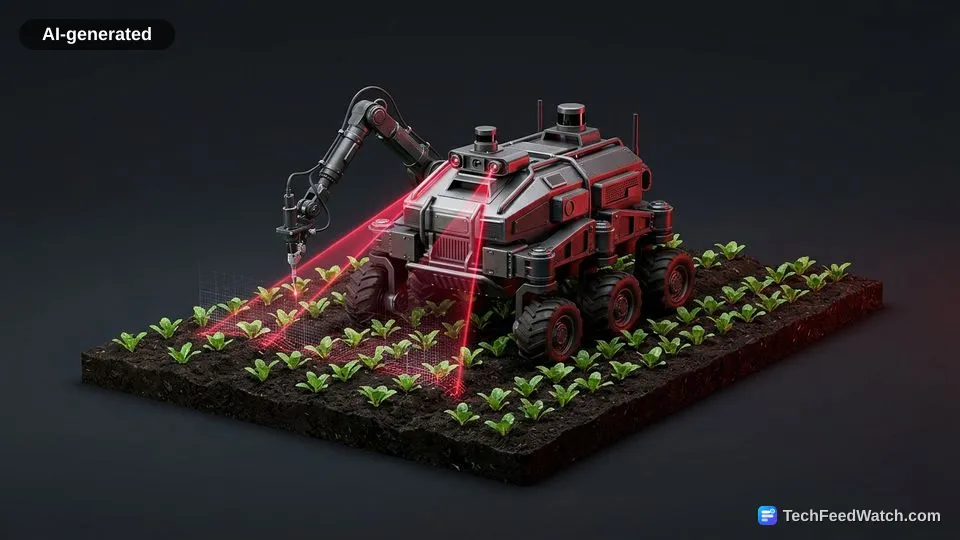
Sensors, computer vision, and GPS guide autonomous machinery
Autonomous farm machinery operates by combining optical sensors, multi-spectral cameras, spatial laser scanners, and satellite navigation to interpret changing field conditions. These hardware components feed real-time environmental data into onboard computers running edge neural networks.
Real-time kinematic global positioning coordinates field movement with sub-inch accuracy. The tractor or implement follows pre-mapped path lines, turns automatically at headlands, and adjusts tool depth according to soil topography.
A USDA Economic Research Service report from December 2024 reviewed guidance system adoption. It noted that autosteering guidance systems operated on 52 percent of midsize farms and 70 percent of large-scale crop farms in 2023.
Computer vision models differentiate cash crops from invasive species in milliseconds. High-speed cameras capture leaves as the machine travels down rows.
Deep learning models then classify species based on shape, leaf texture, and chlorophyll reflectance. Once the system classifies a weed, it fires targeted actuators or thermal lasers directly at the plant root crown.
Sensor fusion ensures physical safety across open ground. Obstacle-detection systems merge lidar scans, ultrasonic rangefinders, and standard visual streams to detect power poles, irrigation risers, stray rocks, and farmworkers. If an unexpected obstacle enters the safety buffer, the autonomous platform stops hydraulic pressure and halts all propulsion instantly.
Field robotics lowers labor costs and improves net returns
Field robotics lowers farm operational expenditures by reducing reliance on manual weeding crews. It also cuts wasted chemical volumes and stabilizes annual production schedules. Farmers offset high initial equipment investments through measurable gains in harvest efficiency and operational margins.
Multi-state research project S1098 cited USDA Economic Research Service figures on farm labor demographics. The data showed that the average age of immigrant farmworkers in the United States increased by 7 years between 2006 and 2021. Autonomous machinery provides reliable field capacity when growers face seasonal labor shortages during critical planting and harvesting windows.
The USDA Economic Research Service reports that precision dairy technologies increase net returns. According to report ERR-356 published in 2026 by the USDA Economic Research Service, installing robotic milking systems raises U.S. farmers’ dairy net returns by an average of 13 percent.
Combining two or more precision dairy technologies delivers that same 13 percent average return increase. These systems harvest milk on individual cow schedules, raising overall herd yields while removing manual milking shifts.
Input efficiency drives savings in specialty crops:
- Targeted nozzle spraying reduces chemical herbicide volumes across targeted rows.
- Laser weeding systems eliminate chemical expenditures entirely on certified organic acreage.
- Automated harvesters work continuous night shifts to pick fruit at peak hydration and coolness.
- Precise fertilizer delivery channels nutrients directly to the root zone without broadcast waste.
What obstacles and operational risks hinder farm robotics adoption?
High capital expenditure, complex field maintenance, fragile software connectivity, and outdoor vulnerabilities restrict rapid agricultural robotics adoption across smaller farming operations. Commercial viability requires equipment that operates reliably through mud, dust, moisture, and extreme temperatures without constant technician intervention.
Equipment access remains skewed heavily toward large agricultural enterprises. A report from the U.S. Government Accountability Office (GAO-24-105962) recorded that only 27 percent of U.S. farms and ranches used precision agriculture practices between June 2022 and June 2023.
High capital costs and sparse rural broadband served as the primary barriers. The USDA Economic Research Service reported in December 2024 that small family farms earning under $350,000 in gross cash farm income had the lowest adoption rates across all automated technology categories.
A February 2026 systematic review of 83 field robotics studies was published by MDPI. The review found that weed and pest robotics face adoption hurdles due to high acquisition pricing, slower working speeds compared to conventional tractors, and insufficient long-term durability in varied soil types.
Mechanical breakdowns during narrow planting or harvest windows risk devastating crop losses if local dealers lack trained robotic repair technicians.
Space weather and radio interference also threaten field navigation:
- Satellite positioning disruptions halt autonomous tractor movement across mapped fields.
- The U.S. National Science Foundation reported in August 2026 that a severe geomagnetic storm occurred in May 2024. This event disabled GPS guidance on tractors across the Midwest, causing hundreds of millions of dollars in operational delays.
- USDA-NIFA safety research from the University of Wisconsin-Madison was presented in 2024. The study warned that autonomous machinery introduces unresolved liability questions regarding bystander safety, unexpected field downtime, and repair protocols.
Abr Media shows autonomous aerial spraying and laser weeding
Abr Media highlights how autonomous machinery transforms field spraying and weed elimination by demonstrating full-sized unmanned aircraft and high-intensity thermal laser platforms.
The creator features the SprayHawk, an uncrewed helicopter built by Rotor Technologies that removes pilots from dangerous aerial spraying runs. Abr Media reports that this uncrewed aircraft carries a 110 gal spray tank across 33 ft booms.
It travels at over 80 mph and stays airborne for 50 minutes per fueling cycle. The uncrewed aircraft can cover more than 240 acres within sixty minutes.
On ground level, Abr Media documents the LaserWeeder G2 manufactured by Carbon Robotics operating in California vegetable fields at midnight. Abr Media notes that the implement uses 240 W diode lasers to burn weeds at the soil line.
The manufacturer reports that its commercial fleet has destroyed more than 10 billion weeds. The creator explains that this thermal method cuts weed management costs by up to 80% while preventing weeds from developing chemical resistance.
The presentation also details autonomous ground sprayers and heavy field implements:
- Abr Media shows the electric GUSS orchard sprayer operating across shifts lasting 10 to 12 hours. One remote operator monitors up to eight of these autonomous sprayers via laptop.
- The video highlights the 1,800-lb Verdant Robotics SharpShooter implement, which travels behind a driverless tractor at up to 5 mph. It fires over 240 targeted applications every second.
- Abr Media reviews the John Deere 9RX 830 autonomous tractor, which delivers 913 hp. The machine reaches a maximum ballasted weight of up to 84,000 lb to maintain traction during field preparation.
- The creator demonstrates the Tribine harvester, which holds 1,000 bushels of grain and unloads at more than 500 bushels a minute. It also carries a 500 gal fuel tank for 24 hours of operation.