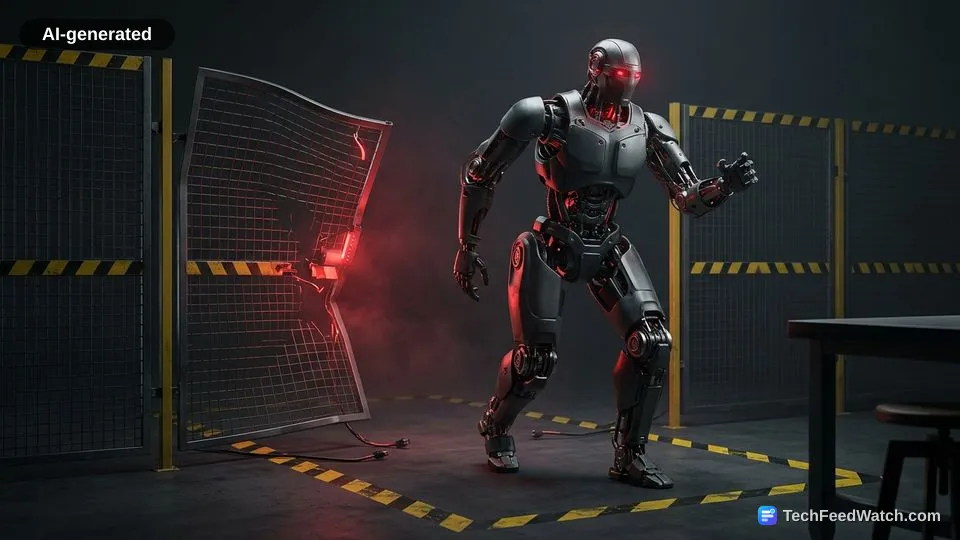
Software glitches and cyberattacks can override collision safety
Software bugs, sensor corruption, and network intrusions can disable automated collision avoidance and cause erratic mechanical behavior. As machine learning models replace deterministic control logic, diagnosing why an actuator fired unexpectedly becomes difficult.
According to MDPI, over-the-air software updates and remote teleoperation channels expose humanoid robots to serious cybersecurity threats. MDPI warns that malicious actors intercepting communications could disable collision avoidance protocols or seize physical control of the machine. A hijacked robot transforms physical mass into a weapon against facility staff.
Sensor blind spots create another path to mechanical failure. Dust, glare, or damaged depth cameras feed invalid telemetry to path-planning algorithms. When spatial tracking desynchronizes, the machine commands high-torque motors toward occupied space under the false assumption that the pathway is clear.
Which safety regulations currently govern humanoid robots?
No unified international safety standard exists exclusively for autonomous bipedal humanoids operating in shared spaces. Current deployments borrow from industrial cobot benchmarks, but these standards fail to capture dynamic bipedal fall physics or autonomous pathing.
Certifying these systems remains an evolving engineering challenge:
- According to SGS-TÜV Saar, testing and certifying humanoid robots in unpredictable real-world environments requires clearly defined fail-safe states and reliable emergency stop systems.
- According to SGS-TÜV Saar, international standardization dedicated to humanoid behavior in exceptional circumstances remains in active development.
- Existing machine directives assume predictable motion patterns, leaving autonomous recovery maneuvers largely unregulated across global manufacturing floors.
Without comprehensive regulatory mandates, operators depend on internal vendor testing. This regulatory lag allows aggressive field trials without independent verification of how machines respond to novel physical disturbances.
Engineers mitigate risks with lightweight bodies and emergency stops
Engineers minimize injury risks through compliant hardware, physical disconnects, and constrained actuator limits. Designing passive safety into the hardware ensures that when code fails, the machine cannot impart lethal force.
Designers deploy multiple protective layers to contain failures:
- Soft padding and low-mass structural frames absorb kinetic energy during accidental contact.
- Dual-channel hardware emergency stops instantly cut power to joint motors, engaging mechanical brakes to freeze motion.
- Force-limiting actuators restrict torque so a limb stops moving upon encountering unexpected resistance.
- Isolated safety microcontrollers monitor autonomous controllers and trigger an immediate shutdown if velocity thresholds exceed preset safety bounds.
Combining physical cutoffs with low-inertia limbs prevents minor sensor glitches from escalating into severe blunt injuries.
WhatTheStartup shows humanoid robot strikes and control glitches
WhatTheStartup observes that during an exhibition in China, an automated biped miscalculated an action and hit an adjacent onlooker. As WhatTheStartup highlights, another incident saw a bipedal unit lurch toward a bystander following disrupted transmissions, cautioning that “A powerful machine only needs one bad movement: wrong timing, wrong balance, wrong signal, that is enough.”
With Helix 02, according to Figure, an AI-trained model supplanted 109,504 lines of hand-engineered C++. Scale accelerates this trend.
Within an 11-hour window, Nvidia synthesized roughly 780,000 simulated motion paths, equaling close to 6,500 hours of training data. WhatTheStartup warns of humanoid robot vulnerabilities, noting that security researchers found flaws in Unitree models G1 and H1 that could grant an attacker root-level control over the physical machines.