Robotics kits advance from tactile play to text coding
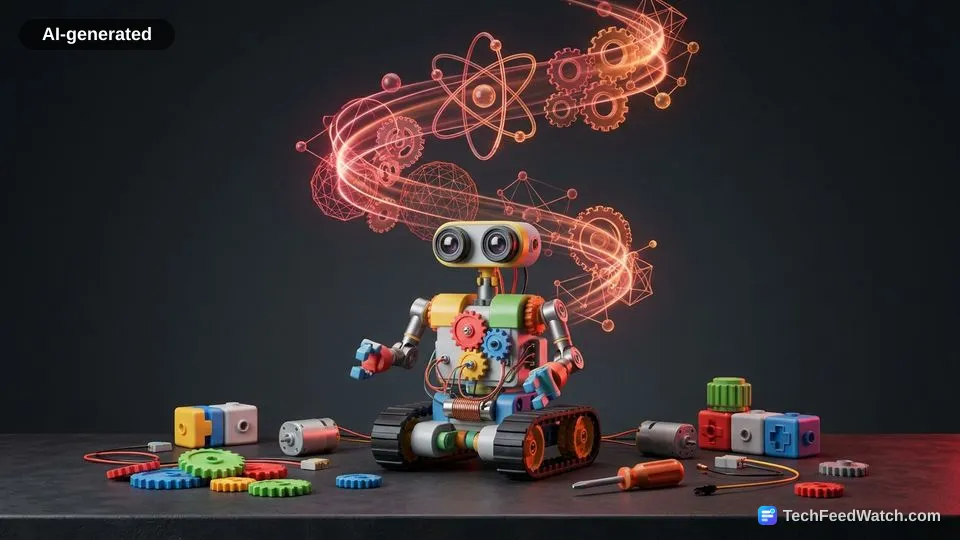
Educational robotics progresses systematically from screen-free tactile assemblies for young learners to visual block coding and formal text-based programming languages for older students.
Early childhood instruction relies on tactile tools without computer screens. Children press directional buttons on rolling toys or lay down colored strips on paper.
These simple physical actions introduce cause-and-effect relationships. Young learners master directional orientation and spatial reasoning before they encounter keyboard commands.
Elementary and middle school classrooms transition students toward visual software interfaces. Children assemble digital instruction blocks on touchscreen tablets to command their machines.
This visual format eliminates syntax punctuation errors while teaching foundational programming logic. Educators frequently use visual tools when they introduce coding for kids to maintain student interest.
Secondary school students advance to industrial programming languages like Python and C++. Learners assemble bare circuit boards, connect jumper wires, and solder electronic connections. Students write raw syntax to calibrate sensor sensitivity and regulate electric motor voltage.
Robotics curricula generally follow distinct developmental stages:
- Screen-free exploration: arranging physical tiles and color codes to direct mobile robots.
- Block programming: snapping graphical software blocks together to build loops and conditions.
- Microcontroller control: wiring external sensors to single-board computers using guided code.
- Text programming: writing full code scripts to automate autonomous vehicle navigation.
Does robotics instruction improve academic and career outcomes?
Empirical research confirms that educational robotics significantly strengthens general STEM academic achievement and career pathways, though computational thinking gains vary across studies.
Evidence shows that robotics-supported STEM education improves students’ conceptual knowledge and applied skills. According to Educational Technology & Society in October 2025, a meta-analysis of 79 independent interventions showed that robotics-supported STEM education produced medium effect sizes (a statistical measure of the strength of an intervention’s impact) on students’ conceptual knowledge (Hedges’ g = 0.636, a metric used to measure effect size) and applied skills (Hedges’ g = 0.663), alongside an effect size of 0.422 on learning attitudes.
Long-term studies demonstrate strong educational attainment among active participants. According to the Center for Youth and Communities at Brandeis University, 90% of students tracked over a decade of participating in after-school robotics programs completed a college degree, compared to a 55% national completion benchmark.
Participation also changes higher education subject selection. According to Brandeis University’s Heller School for Social Policy and Management in its 10-Year FIRST Longitudinal Study Final Report, female alumni of youth robotics competitions took university coursework in engineering at 3.7 times the rate and computer science at 5.3 times the rate of a matched comparison group.
However, mechanical assembly does not guarantee mastery of general computer science. According to a multilevel meta-analysis of 21 studies published on ResearchGate in 2024, educational robotics produced moderate-sized positive effects on students’ overall STEM academic performance, but yielded statistically insignificant gains in computational thinking. Students still require focused computer science lessons to master abstract logic.
Equipment costs and training gaps hinder classroom implementation
Schools face steep hurdles when implementing robotics programs due to restrictive equipment budgets, aging technical infrastructure, and an absence of formal teacher training.
Classroom robotics requires substantial capital investment for initial purchase orders and ongoing part replacements. According to Taylor & Francis in an October 2025 survey of 302 preschool and primary educators, major obstacles to implementing robotics in schools included infrastructure limitations reported by 85.5% of respondents, reliance on technical support reported by 81.0%, and equipment cost or availability reported by 59.3%.
The October 2025 survey from Taylor & Francis documented widespread administrative challenges:
| Implementation Barrier | Percentage of Educators Reporting |
|---|---|
| Infrastructure limitations | 85.5% |
| Reliance on technical support | 81.0% |
| Equipment cost or availability | 59.3% |
Curricular design presents another hurdle for schools. According to Purdue University’s Journal of Pre-College Engineering Education Research in a systematic review of 147 studies, robotics positively impacts learner motivation and skill transfer across K–12 classrooms, but the lack of standardized teacher training and curriculum scaffolding limits consistent educational outcomes. Teachers often receive hardware kits without clear lesson plans.
School systems must allocate funds for teacher workshops alongside hardware purchases. According to Purdue University’s Journal of Pre-College Engineering Education Research, the lack of standardized teacher training limits consistent educational outcomes. Effective robotics education in schools depends entirely on supported, well-trained classroom instructors.
Make Life Smart explores five interactive learning robots for kids
Make Life Smart reviews five dedicated consumer robots designed to support literacy, basic coding, conversational social development, and general home tutoring for children.
Make Life Smart notes that Luka is an owl-shaped reading companion built to read physical books aloud. According to Make Life Smart, Luka uses an integrated camera to recognize pages across thousands of books on a home shelf, providing expressive character voices.
The creator also highlights a palm-sized interactive robot built for progressive classroom coding. The unit reads hand-drawn marker lines on paper before advancing students to visual blocks and text code. Make Life Smart states the robot moves, spins, and lights up to show immediate visual feedback as students test written commands.
To build social capabilities, Make Life Smart introduces Moxie, a conversational AI robot built for children between 5 and 10 years old. The creator explains that Moxie uses interactive games and dialogue to build emotional communication skills.
For home questions, Make Life Smart presents the Amazon Echo Dot Kids speaker, which features an owl design and an Echo Glow light. Make Life Smart notes the Amazon Echo Dot Kids answers curiosity questions at 7:00 p.m. or at midnight. Finally, the creator highlights Miko Mini+, an AI unit that adjusts STEM games to a child’s learning pace.