Robotics activities boost student achievement and engagement
According to Educational Research Review, robotics applications produce low-to-moderate positive effects, while the International Journal of STEM Education found moderate positive effects. These positive effects occur in academic achievement, computational thinking, and learning attitudes.
According to a 2026 three-level meta-analysis (a study combining multiple research projects) in Educational Research Review, educational robotic applications exert a clear impact. They show a statistically significant, positive, low-to-moderate overall effect on academic achievement.
This effect appears across primary, secondary, and higher education contexts. Physical experimentation grounds complex formulas into visible actions.
Robotics programs also build broader cognitive (mental and reasoning) habits. According to a multilevel meta-analysis published in the International Journal of STEM Education, robotics interventions produce moderate positive effect sizes.
When pupils build code to operate a machine, they learn how to break complex problems into sequential commands. Working in teams to complete robot challenges also builds social coordination and communication habits.
A 2026 meta-analysis published in Frontiers in Robotics and AI examined 146 studies. It evaluated how different social robot deployment models affect learning outcomes.
| Deployment Model | Effect Size (Cohen’s d) | Relative Outcome |
|---|---|---|
| Social robot co-teaching with a human educator | d = 0.88 | Strong positive gain |
| Social robot operating as a solo replacement teacher | d = -0.06 | No measurable benefit |
| Social robot compared to no-training control group | d = 0.75 | Moderate-to-strong positive gain |
| Social robot compared directly to human instruction | d = 0.31 | Small positive gain |
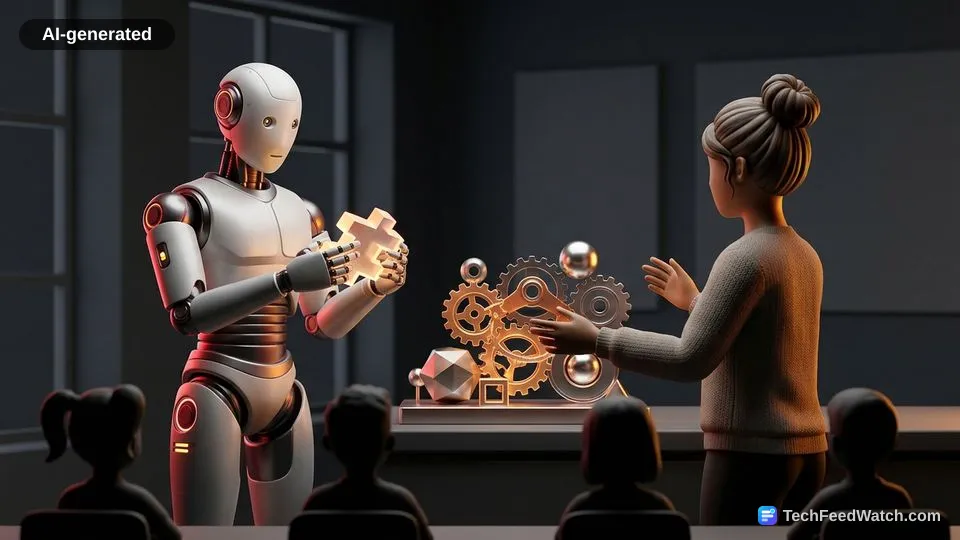
According to Frontiers in Robotics and AI, social robots operating alongside human teachers yield a strong cognitive learning gain of d = 0.88. In contrast, running a robot alone without an instructor produces an effect size of d = -0.06.
According to Frontiers in Robotics and AI, social robots functioning in a co-teaching role produce a strong positive effect on cognitive learning outcomes. Robots deployed to replace teachers show no benefit, according to Frontiers in Robotics and AI.
How do telepresence robots support homebound students?
Telepresence robots support homebound students by providing an active, motorized video connection. This connection lets them participate directly in school life.
According to the Association for Computing Machinery, telepresence robots provide homebound students facing severe illness with physical mobility and classroom social interaction. Many homebound children receive only 4 to 5 hours of isolated tutoring per week, according to the Association for Computing Machinery.
A rolling telepresence unit helps bridge that social gap. It lets the child attend full school days alongside peers.
These devices use a motorized base, a vertical pole, and a tablet screen to represent the student. According to the New South Wales Department of Education, remote students steer their own line of sight, physical vantage point, and peer conversations.
They control the robot directly from a personal computer, tablet, or mobile phone. The child controls where the robot looks. This allows them to turn toward the whiteboard or swivel to face a classmate during discussions.
That physical autonomy (independent movement) prevents the isolation that standard video conference links cause. Remote students can roll down hallways between classes and sit at lunch tables with friends. Feeling included among peers protects their emotional well-being during long hospital stays or medical recovery periods.
Technical limits prevent robots from replacing human teachers
Technical limits in natural language processing (computer processing of human speech) and high equipment costs keep robots from taking over teaching duties.
According to Science Robotics, a study led by University of Plymouth roboticist Tony Belpaeme showed that social robots match human tutoring effectiveness in narrow, highly defined subjects. This matching effectiveness happens only in narrow, highly defined subjects like prime numbers or vocabulary acquisition. However, Belpaeme noted that current technical deficits in speech recognition and social interaction prevent robots from managing broader instructional roles.
Classrooms are loud and chaotic. Current machine models struggle to parse (interpret) overlapping child speech. They also struggle to detect subtle signs of emotional confusion.
Educators also voice strong skepticism toward automated teaching. According to a Big Ideas survey published by Education Week, 84 percent of K-12 educators disagreed with one major idea. They disagreed that student learning would improve if teachers used AI-powered robot assistants in classrooms.
Education Week found that over 90 percent of surveyed teachers rejected replacing low-performing educators with robots. Teachers recognize that empathy, behavioral discipline, and contextual encouragement require human emotional intelligence.
Schools encounter practical roadblocks when attempting to deploy these technologies at scale:
- High hardware acquisition (purchasing) expenses that strain standard school district budgets.
- Deficient Wi-Fi coverage and electrical infrastructure in aging school buildings.
- A lack of structured teacher training programs on integrating hardware into existing curriculum standards.
According to the Erasmus+ RoboCOOP cross-national survey across Germany, Poland, Spain, and Turkey, teachers identified several primary obstacles to adopting social robots. These obstacles include high purchase costs, inadequate school infrastructure, and a lack of pedagogical training. Buying expensive hardware without investing in instructor training frequently leads to equipment sitting unused in storage closets.
I completely share that hesitation about pushing machines into roles meant for people. When I call my bank and get an automated voice, I always prefer speaking to an actual person instead. Automated systems make a useful aid, but they still produce unexpected mistakes and cannot provide genuine empathy.
The Construct Robotics Institute teaches ROS with BotBox Warehouse
The Construct Robotics Institute teaches the Robot Operating System (ROS, software for controlling robot parts). It walks educators through common programming errors using physical and simulated (computer-modeled) warehouse robots.
In a training demonstration, presenter Desire showed how educators can structure technical robotics lessons using the BotBox Warehouse setup. The system includes three robots.
Educators can also add a robotic arm and a conveyor belt to simulate industrial workflows. The presentation explained that students frequently understand programming syntax (code rules). However, students struggle with invisible coordinate systems known as frames in ROS 2.
To fix these student misconceptions, The Construct Robotics Institute uses a structured teaching routine:
- Predict: The educator asks students to forecast the machine’s exact movement before executing modified code.
- Run: The teacher runs the program so students observe the actual physical behavior of the robot.
- Explain: The instructor breaks down the underlying coordinate frame mistake that caused the specific motion.
Desire demonstrated this routine using a red mobile base called FastBot. In one exercise, the robot received instructions to move 0.3 m between its axes at an angle of 45°. This movement was set within an 8 seconds duration limit.
Desire explained that students often store coordinate goals relative to the moving robot base rather than a fixed room frame. The base moves continuously. Because of this, setting a goal half a meter ahead causes the target to stay half a meter away indefinitely.
The demonstration also illustrated how timing changes affect behavior by adjusting the execution limit to 20 seconds. In another example, improper coordinate frame calls caused the robot to rotate 90° off course. According to The Construct Robotics Institute, demonstrating physical robot failures helps students correct coordinate frame errors.
Connecting abstract code directly to physical movement makes an enormous difference. I once drove past a robot being tested on an open street to see how it handled the real world, and watching it navigate was fascinating. Letting students see their instructions succeed or fail in front of them teaches troubleshooting far faster than pure theory.
Why it matters
Educational robots work best as tools to teach programming, foster teamwork, and bring isolated students into the physical room. School districts that invest in teacher training and reliable hardware will see genuine educational returns. Meanwhile, districts buying gadgets without structured lesson plans risk wasting limited public funds.