Quantum algorithms accelerate complex model training and optimization
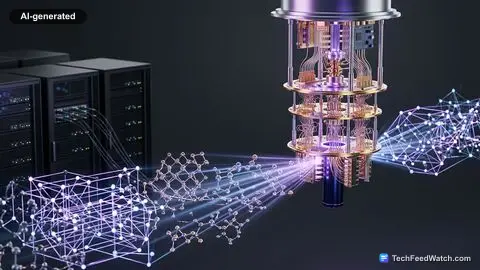
Quantum algorithms accelerate complex model training by calculating vast arrays of probabilities simultaneously. They do this rather than checking potential solutions one after another.
Artificial intelligence models grow larger each year. This growth creates an intense demand for electrical power and processing hardware.
IBM Research reported in February 2025 that artificial intelligence compute requirements for large training models have been doubling every six months. This rapid surge strains silicon chips. It forces developers to seek alternative processors for complex mathematical tasks.
Quantum processors excel at combinatorial optimization. This math searches for the single best option among billions of combinations. Classical computers test these options sequentially (one after another).
A quantum processor evaluates multiple possibilities together. This capability saves time when training deep neural networks (layered artificial intelligence models).
The table below compares classical and quantum performance metrics.
| Metric | Classical Systems | Quantum Systems | Source |
|---|---|---|---|
| Verification benchmark runtime | 10 septillion years | Under 5 minutes | Google Quantum AI (Dec 2024) |
| Compute demand growth rate | Doubling every 6 months | Target for energy relief | IBM Research (Feb 2025) |
| Projected life sciences value | Baseline computational speed | $200B to $500B by 2035 | McKinsey & Company (2025) |
McKinsey & Company’s Quantum Technology Monitor 2025 offers a key projection. The report projects that quantum computing will generate between $200 billion and $500 billion in value for the life sciences sector by 2035.
Classical artificial intelligence struggles to simulate subatomic molecular bonds accurately. Quantum chips naturally replicate those physical states. They succeed because the processors operate using the exact same physical rules.
Watching this development combine with artificial intelligence is genuinely exciting. In my view, these processors will prove far more potent than many realize once major tech corporations deploy them at scale. Rather than feeling intimidated by the sheer speed of change, keeping up with these breakthroughs helps you stay ahead.
How does artificial intelligence stabilize quantum computers?
Artificial intelligence stabilizes quantum computers by analyzing hardware noise patterns. It automatically applies corrections to protect sensitive qubit data.
Quantum processors are fragile machines. Slight temperature fluctuations, stray electromagnetic waves, or physical vibrations disrupt qubits.
These factors cause qubits to lose their computational states. Scientists call this loss decoherence. When decoherence happens, calculations fail and data disappears.
To combat this instability, engineers train classical machine learning algorithms to monitor quantum chips continuously. McKinsey & Company explains that classical machine learning helps scientists analyze hardware noise patterns.
It also helps automate quantum error correction. By studying historical error data, artificial intelligence spots when a qubit drifts out of alignment. It then corrects the qubit before the calculation breaks.
Recent hardware milestones demonstrate this steady progress:
- Google Quantum AI announced its 105-qubit Willow chip in December 2024.
- Google Quantum AI showed that physical error rates decrease exponentially as qubit counts scale up on the chip.
- Willow completed a benchmark verification task in under five minutes.
- Google Quantum AI calculated that the same task would take classical supercomputers an estimated 10 septillion years.
Classical machine learning runs background diagnostics (system health checks). Without it, scaling up qubit counts would produce too many errors to complete accurate work.
Physical limits and data bottlenecks hold back quantum chips
Physical limits, hardware cooling demands, and data conversion delays slow development. These factors currently prevent quantum processors from replacing standard artificial intelligence chips.
Data movement forms one of the largest structural obstacles. IBM Research notes that applying quantum machine learning to classical datasets faces hurdles.
One major hurdle is the lack of scalable quantum random-access memory (QRAM) for long-term quantum data storage. Without functional QRAM, computers cannot store quantum states for future use.
Converting data creates a second major friction point. IBM Research highlights the computational difficulty of converting classical training data into quantum states efficiently.
Loading a massive image database or large text library into a quantum processor takes significant time. This delay erases much of the computational speed advantage gained during processing.
Physical hardware requirements also restrict widespread deployment. Quantum processors require extreme refrigeration units that cool chips down near absolute zero. Because of these cooling demands, individual consumers and normal businesses cannot run physical quantum hardware in their offices.
According to the Cloud Security Alliance, practical commercial quantum advantage across complex workflows will emerge between 2030 and 2031. Quantum advantage is the point where quantum systems outperform traditional computers on real-world business tasks. The Cloud Security Alliance states that initial enterprise adoption will happen via cloud access rather than on-premises hardware.
This developmental timeline means everyday computer users will not see quantum chips inside laptops or smartphones. Instead, major cloud networks will manage the physical cryogenics (specialized ultra-cold refrigeration). These networks will route specialized computational tasks to quantum processing units behind the scenes.
No private consumer is ever going to purchase one of these rigs, but renting compute time over the cloud works just like buying remote storage. In my view, large institutions such as weather forecast services and hospital networks will be the natural users who actually need that massive capacity. For the rest of us, relying on standard networks to handle daily tasks remains more than adequate.
Cloud With Vincent breaks down quantum mechanics for AI
The educational channel Cloud With Vincent explains three key quantum principles. These are superposition (existing in multiple states at once) and entanglement (particles remaining interconnected so one dictates another).
They also include interference (amplifying correct answers while canceling out errors). These features allow quantum hardware to handle artificial intelligence problems that overwhelm standard computers.
Vincent illustrates qubit behavior using the physical example of a spinning coin. A traditional bit functions like a switch that rests on either heads or tails. In contrast, a spinning coin represents both states at the same time until it lands on a surface.
To demonstrate superposition in everyday logistics, Vincent compares classical routing to a car navigation unit. A classical GPS tests city routes one after another.
A quantum navigation system explores every possible street path simultaneously. Vincent adds that Albert Einstein famously described quantum entanglement as “spooky action at a distance.”
The educational video highlights several real-world examples and industry figures:
- According to Nature, Google demonstrated quantum supremacy in 2019 when its chip solved a problem in about 200 seconds that would take a supercomputer approximately 10,000 years.
- Software developers can begin building quantum algorithms today using Python and IBM’s Qiskit framework.
- Vincent points out that annual compensation for quantum computing engineers in the US typically ranges from $130,000 to $250,000.
- Vincent compares the current development stage of quantum technology to the early state of the public internet back in 1993.
Vincent argues that quantum computing provides the necessary power to advance artificial intelligence models that process trillions of variables. “Quantum computing is the key that opens up the next 100 years of human progress, and AI is going to be its biggest beneficiary.”
Try the numbers yourself in our Quantum Speed-up Calculator.