Why error correction defines modern quantum hardware roadmaps
The transition from theoretical physics to functional quantum hardware hinges on error correction. Existing quantum devices remain noisy, suffering errors every few hundred or thousand cycles. When noise accumulates, delicate superpositions decay, degrading complex calculations into useless static before completion.
An error-corrected qubit is one you can actually trust to hold a value while you compute with it. Achieving this reliability requires pooling many physical qubits into a single shielded logical unit. As The Quantum Bull points out, getting 200 error-corrected qubits represents a completely different engineering milestone from stringing together 200 raw, noisy physical qubits.
Major hardware roadmaps have now attached hard dates to these fault-tolerant thresholds. IBM committed to deploying a machine called Starling in New York delivered in 2029.
Starling aims to run 200 error-corrected qubits through 100 million operations in a single computation. In technical documentation, IBM stated that mapping the computational state of Starling would demand the memory capacity of more than a quindecillion of the world’s most powerful supercomputers, with a quindecillion measured as 10 to the 48th.
Simultaneously, competing architectures are hitting their stride. Hardware developer QuEra scheduled a system called Libra arriving on Amazon’s Cloud in 2028. Libra aims to provide 256 error-corrected qubits with an error rate of about one error per million operations.
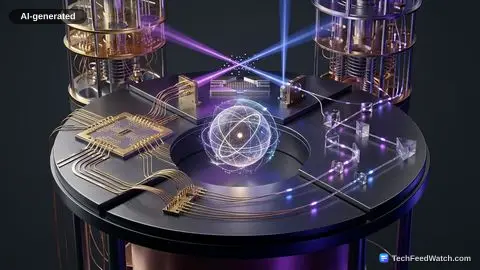
While IBM builds circuits out of superconducting metals cooled near absolute zero, QuEra suspends neutral atoms in vacuum chambers using laser beams. Despite divergent physical designs, both efforts target identical scale. Overcoming the physical bottlenecks detailed in The Engineering Roadblocks to Scalable Qubits represents the primary focus of both development tracks.
The staggering scale of a 256 qubit system
The capacity enabled by a 256-qubit system reshapes how computational scale is measured against physical reality. The human body contains roughly 10 to the 27 atoms. The Earth, including its crust, mantle, and molten iron core, contains about 10 to the 50th atoms.
The Sun measures 10 to the 57 atoms. Across the Milky Way, every star, orbiting planet, and drift of interstellar dust amounts to roughly 10 to the 68th atoms. A 256-qubit processor holding 10 to the 77 states provides a working memory space roughly one billion times larger than the atom count of our galaxy.
To comprehend that volume, imagine taking every atom in the Earth—all 10 to the 50th of them—and converting each into an independent computer capable of processing one billion states per second.
If that planetary network started running at the Big Bang, 14 billion years ago, it would only be about halfway through counting the states held inside a 256-qubit machine today. Because the observable universe holds somewhere around 10 to the 80th atoms, this mathematical space represents roughly 1/1,000th of all physical matter in existence.
Yet querying that enormous machine collapses the entire state into a simple measurement: exactly 256 bits, roughly the length of a long password. The remaining data does not hide; physical collapse erases it completely.
This reality clarifies why quantum computing differs from standard memory expansion. The machine does not search that vast space linearly; it shapes it.
Quantum states function like waves, which naturally cancel or reinforce one another. When wave peaks meet troughs, they cancel out, leaving flat water behind.
An algorithm is a machine for arranging that cancellation so that the wrong answers wipe each other out and the right one is the only thing still standing when you look. Without specialized algorithms that induce constructive and destructive interference, quantum chips offer no operational advantage, which Understanding Quantum Computing Applications and Capabilities clarifies when filtering industrial workloads.
Where quantum hardware will actually be put to work
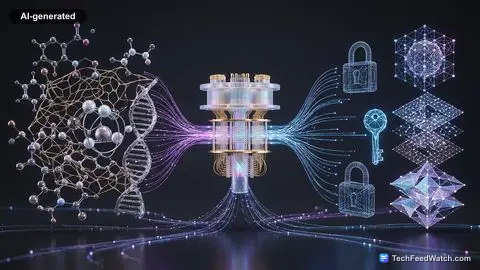
Because quantum execution relies entirely on mathematical interference, quantum processors will not replace classical central processing units for basic business logic, database queries, or spreadsheets. The industry remains laser-focused on specific, intractable domains where nature itself operates quantum mechanically:
- Molecular synthesis
- Battery chemistry
- Structural metallurgy
In the seventeenth century, Galileo ground a lens to get a better look at ships coming into the harbor, but pointing the instrument upward exposed the moons of Jupiter. Modern quantum engineering stands at an identical juncture. Physicist Richard Feynman famously observed that nature is not classical, concluding that simulating physical reality accurately requires hardware built on non-classical principles.
After 48 years of theoretical groundwork, physical machines capable of simulating molecular bonds without classical approximations are nearing deployment. Over the next several years, verification of QuEra’s Libra in 2028 and IBM’s Starling in 2029 will determine whether fault-tolerant logic meets commercial timelines or encounters unforeseen engineering ceilings.