Difference Between Qubit and Classical Bit Explained

Researched with a video published on YouTube by Qubit Ink. TechFeedWatch is not affiliated with the creator, and all rights to the video remain theirs.

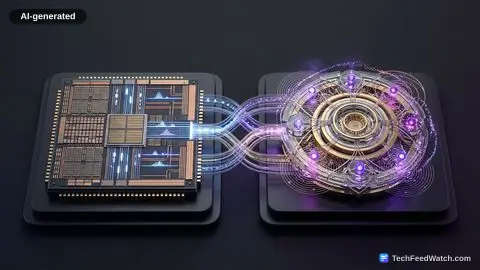
A classical bit operates as an absolute binary switch, resting squarely at zero or one, while a qubit exists in a continuum of quantum states governed by complex probability amplitudes. Understanding this distinction clarifies why quantum processors do not simply perform classical calculations faster, but execute fundamentally different computational logic. The true operational divergence appears when qubits interact through quantum gates, generating exponential computational spaces and entanglement that classical architectures cannot replicate.

The difference between qubit and classical bit computation begins with physical reality. The central idea is this: information is physical.

A classical bit is a definite binary state of zero or one, whereas a qubit is a quantum system described by a superposition of two computational basis states, ket 0 and ket 1. A qubit is not simply a classical bit that is secretly both zero and one; a qubit state carries complex amplitudes that directly interfere with one another.

Measurement is where quantum information becomes a classical outcome. When an operator measures a qubit, those amplitudes collapse into a single classical result, making the behavior of the unit radically different from the deterministic switches powering conventional silicon.

Real Difference Between Qubit and Classical Bit Systems

At its core, classical computing relies on discrete voltages, currents, or magnetic domains to represent definite states. In 1936, Alan Turing formalized the mathematical model of an algorithm, and in 1948, Claude Shannon established the mathematical foundations of classical information theory. In this classical framework, logic gates execute predictable operations.

For instance, classical logic gates operate on definite inputs: a NOT gate changes zero to one and one to zero, while an AND gate inspects two input bits and returns one only when both inputs equal one. The state remains completely transparent throughout the computation.

Quantum mechanics upends this determinism. Quantum theory began in the early 20th century when classical physics failed to explain atoms, radiation, and microscopic matter. Decades later, researchers realized that computing could leverage these physical phenomena directly.

In 1982, Richard Feynman argued that classical machines could not simulate quantum physics efficiently, pointing out that modeling quantum systems requires a quantum architecture. In 1985, David Deutsch developed the formal concept of a universal quantum computer, and by the mid-1990s, algorithmic breakthroughs changed the trajectory of the field.

Peter Shor demonstrated that a quantum machine could factor integers efficiently, and Lov Grover proved that quantum search could outpace classical unstructured search. Understanding how quantum computing differs from classical computing requires stepping away from simple switch metaphors and examining physical states.

A qubit is expressed mathematically as ket psi equals alpha ket 0 plus beta ket 1. The values alpha and beta are complex amplitudes rather than basic probabilities.

The absolute square of alpha plus the absolute square of beta must equal one to preserve total probability. A pure single-qubit state maps cleanly onto the Bloch sphere, a geometric model where the north pole represents ket 0, the south pole represents ket 1, and the equator marks equal-weight superpositions with distinct relative phases.

The relative phase does not alter immediate raw probabilities, but it dictates how states interfere when manipulated by quantum gates. Measurement acts as an active physical operation rather than a passive inspection.

When measured in the computational basis, a qubit in state alpha ket 0 plus beta ket 1 yields zero with probability equal to the absolute square of alpha, and one with probability equal to the absolute square of beta. Once measured, the state collapses entirely into the observed basis state.

Watch: the video

14 min video by Qubit Ink.

Scaling Beyond Single Units with Entanglement and Gates

Single-qubit operations manipulate these states via unitary transformations, which preserve probability while rotating amplitudes. The X gate is the quantum version of a bit flip.

It maps ket 0 to ket 1, and ket 1 to ket 0. The Z gate is a phase flip. It leaves ket 0 unchanged, but changes ket 1 to minus ket 1.

If we apply H to ket 0, we obtain ket 0 plus ket 1, divided by square root of two. If we apply H to ket 1, we obtain ket 0 minus ket 1, divided by square root of two.

When architectures scale, the distinction between classical and quantum units widens dramatically. Two classical bits produce four possible static states:

  • 00
  • 01
  • 10
  • 11

Two qubits possess four computational basis states—ket 00, ket 01, ket 10, and ket 11—held simultaneously within a continuous state vector. For n qubits, the system contains 2 to the power n computational basis states.

As Qubit Ink points out, based on foundational principles detailed in the classic text Quantum Computation and Quantum Information by Michael Nielsen and Isaac Chuang, published by Cambridge University Press, this mathematical scaling does not mean a programmer simply reads out 2 to the power n classical values. Extracting computational value requires multi-qubit gates that exploit interference and entanglement.

The controlled-NOT, or CNOT gate, exemplifies this dynamic. It assigns a control qubit and a target qubit. If the control qubit is zero, the target remains unchanged; if the control qubit is one, the target flips.

In basis terms, ket 00 remains ket 00, ket 01 remains ket 01, ket 10 becomes ket 11, and ket 11 becomes ket 10. When the control qubit enters the gate already in a superposition, the operation creates an entangled state.

Consider building the Bell state Phi-plus using tools like Python and Qiskit. The circuit begins with the two-qubit input ket 00.

Applying a Hadamard gate to the first qubit creates an equal superposition on the control wire while the second wire stays ket 0, forming ket 00 plus ket 10 divided by the square root of two. Feeding this state through a CNOT gate produces the Bell state: ket 00 plus ket 11 divided by the square root of two.

There are four Bell states. If we measure the first qubit alone, we get zero with probability one-half and one with probability one-half. The result appears purely random locally.

Yet measuring the second qubit always yields an identical result: zero matches zero, and one matches one. The joint state cannot factor into two independent single-qubit descriptions.

Why Qubits Are Not Just Faster Classical Bits

A qubit is not a faster classical bit, nor is it an ordinary bit hiding two numbers at the same time. It is a distinct physical construct that replaces binary certainty with complex probability amplitudes, relative phase shifts, and non-local correlations. Classical architectures remain unmatched for deterministic, linear logic.

Quantum processors derive their power exclusively from mathematical interference across an exponential state space before measurement collapses that space into a classical readout. Treating a qubit as an upgraded transistor misses the point; it represents an entirely different set of physical rules for manipulating information.

Frequently Asked Questions

What is the main difference between a qubit and a classical bit?

A classical bit exists strictly as a zero or a one, whereas a qubit exists in a superposition of states defined by complex amplitudes. Measurement forces the qubit to collapse into a single classical outcome.

Does a qubit store infinite information because of superposition?

No. Although a qubit state contains continuous amplitudes before measurement, measuring it in the computational basis yields only a single classical bit of information.

How do quantum gates differ from classical logic gates?

Classical gates perform deterministic operations like bit flips and logical conjunctions, while quantum gates apply reversible unitary transformations that alter amplitudes and relative phases. These transformations can create superposition and entangle multiple qubits.

Jacob S. Olsen

Jacob S. Olsen

Runs TechFeedWatch, from Denmark

How this article was made: every article starts from two things — a question people search for on Google, and a video from an independent creator on that subject. A language model writes the article to answer the question, using the video's transcript as its research material. It publishes automatically — I do not read every article before it goes live. The creator is credited on this page.

What is mine is the machinery and the rules it follows: which subjects, which sources, what gets rejected, and what this site is allowed to claim. More on that here — and if something is wrong, tell me.