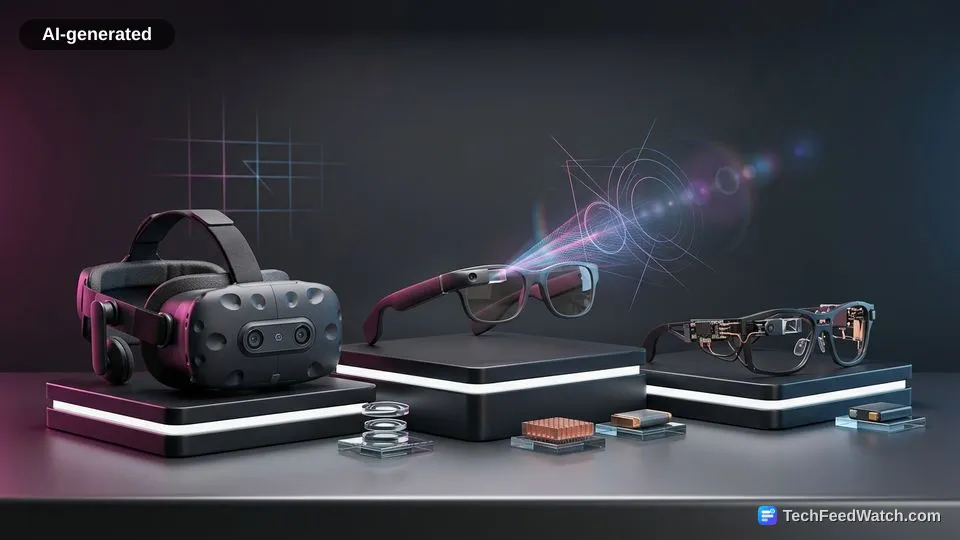
Commercially available AR headsets and smart display glasses
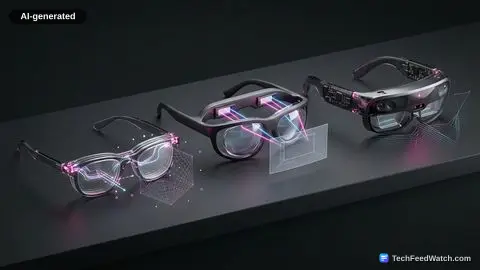
Commercial augmented reality hardware is available for purchase right now. However, products divide sharply between enterprise headsets, standalone developer kits, and consumer display glasses.
Enterprise customers utilize bulky headsets designed for high-precision industrial work, healthcare training, and field service. Meanwhile, consumers purchase lightweight display glasses.
These glasses plug into smartphones or gaming handhelds to project simulated theater screens. Recently, standalone frames entered the market. These frames house their own batteries, sensors, and processors directly on the spectacle frame itself.
According to product specifications published by Magic Leap, PCMag, and IGN, commercial spatial and display eyewear varies dramatically across design, optics, and price:
| Device | Device Weight | Optical System | Retail Price |
|---|---|---|---|
| Magic Leap 2 | 260 grams | 70-degree diagonal FOV waveguides | Enterprise pricing |
| Viture Pro 2 | 63 grams (2.22 ounces) | Micro-OLED prisms (1,600 nits) | $299 |
| Snap SPECS | 4.6 ounces | 51-degree FOV waveguides | $2,195 |
The commercial market currently splits into several distinct hardware approaches:
- Wearable display glasses that plug directly into external phones to act as lightweight media monitors.
- Heavyweight enterprise headsets that connect to waist-mounted battery and computing packs for medical and industrial work.
- Standalone developer glasses that fit computing chips, spatial sensors, and battery cells entirely inside the eyeglass frame.
According to Magic Leap, its Magic Leap 2 enterprise AR device launched commercially on September 30, 2022. It provides dynamic dimming and an AMD Zen 2 processor alongside its 70-degree diagonal field of view.
They use optical prisms to project virtual desktop monitors. According to IGN, Snap opened commercial preorders in October 2026 for its standalone SPECS glasses at a price of $2,195. The hardware sports transparent waveguide lenses (optical components that route projected light directly into the wearer’s eyes) and dual Snapdragon chips.
To be completely honest, I have no personal experience with AR glasses myself, but I think the hardware is genuinely fantastic. They can deliver an entirely different experience of reality, like helping patients work through anxiety. That kind of practical value is why it pays to understand what these tools can actually do.
What advanced AR prototypes are tech companies developing?
Major technology companies are developing advanced laboratory prototypes. These prototypes integrate wide-angle optical displays, onboard computing, and spatial tracking into standard optical frames.
These experimental units prove that wide field-of-view spatial computing fits into glasses-style frames. However, manufacturing yields (the percentage of usable finished products) remain low. Engineers build these devices to test human interfaces and software architectures before mass manufacturing becomes economically viable.
According to Meta, the company unveiled its Orion prototype in September 2024 as its first fully functional pair of true augmented reality glasses. The Orion prototype weighs 98 grams.
It provides a 70-degree field of view using silicon carbide lenses rather than ordinary optical glass. According to Meta, Orion projects imagery via microscopic microLED engines. It tracks user intentions using an electromyography (EMG) wristband that detects neural electrical impulses alongside eye-gaze tracking.
Hardware hurdles delaying mainstream consumer AR glasses
Engineering limits prevent true AR glasses from reaching mainstream store shelves. These limits involve battery chemistry, optical physics, heat dissipation (spreading heat away), and manufacturing yields.
Optical waveguides lose a massive percentage of light between the internal projector and the wearer’s retina. To overcome this light loss, projectors must run at scorching brightness levels. This requirement consumes massive amounts of battery power.
Shoving high-density batteries and fast computing silicon into glasses creates uncomfortable heat right next to the user’s temples. Ordinary prescription glasses weigh far less. Heavier computing frames become fatiguing over long sessions.
The primary hardware barriers delaying everyday consumer adoption include:
- Thermal limits that restrict how long onboard processors can run without active cooling fans.
- Waveguide light transmission losses that demand intense display power draw.
- Battery energy density limits that force trade-offs between frame weight and operating runtime.
- High fabrication costs for specialized optical materials like silicon carbide.
For shoppers, these hardware limits mean that current low-cost consumer smart glasses will not replace your phone anytime soon. PCMag notes that budget wearable glasses function strictly as external monitors rather than spatial computers.
If you buy wearable glasses today, expect a tethered secondary screen or basic audio assistance. Do not expect a holographic substitute for your desktop computer.
Looking at these physical limits reminds us to use common sense rather than getting carried away by hype. I believe it is our duty to follow the technology closely so we know what we are dealing with. Once you gain clear insight into where things are heading, it becomes much easier to navigate the market.
Nathie tests Snap’s standalone Specs AR glasses
Tech reviewer Nathie tested Snap’s standalone SPECS AR glasses to evaluate how untethered augmented reality performs in real environments.
Nathie highlighted that the SPECS operate without a separate computing puck or mobile phone tether. Instead, they run software entirely on the headset itself. Snap achieves this standalone performance by dividing duties between two Snapdragon processors.
One chip manages user experiences. The second processor handles computer vision and spatial environmental tracking. Nathie pointed out that Snap opened preorders for the hardware at $2,195.
The frames ship in 47 mm and 52 mm sizes, weighing 132 or 136 grams. Nathie noted that he started feeling the hardware’s weight on his face after roughly 20 minutes of wear. The visual system provides a 51-degree field of view with 90 Hz displays in both eyes.
In addition, electrochromic dimming lenses darken electronically to increase contrast. For comparison, Nathie noted his Meta Ray-Ban display glasses feature a monocular display (a screen for only one eye). For comparison, his Meta Ray-Ban display glasses have a much narrower 20-degree field of view.
Nathie observed practical trade-offs during his 30-minute testing session. Virtual objects lacked physical hand occlusion (blocking virtual images when hands are in front). This meant 3D graphics rendered directly over his fingers.
Snap advertises up to 4 hours of mixed use. However, Nathie estimated that heavy spatial computing would drop practical battery life closer to 3 hours. Nathie concluded that “right now, they feel more like a platform for developers, early adopters, and Snap itself to figure out what works before the hardware eventually becomes smaller, lighter, and hopefully, a lot cheaper.”
Snap partners with Verizon as its official distributor in the United States. This arrangement gives developers access to over 5 million lenses created in Lens Studio, Snap’s augmented reality creation software.