Standalone and tethered headsets balance processing power with portability
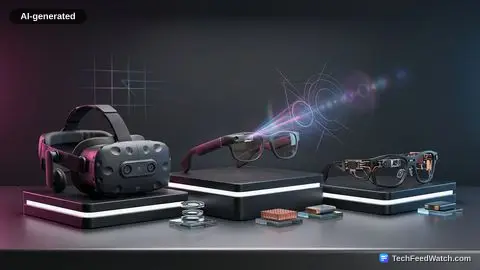
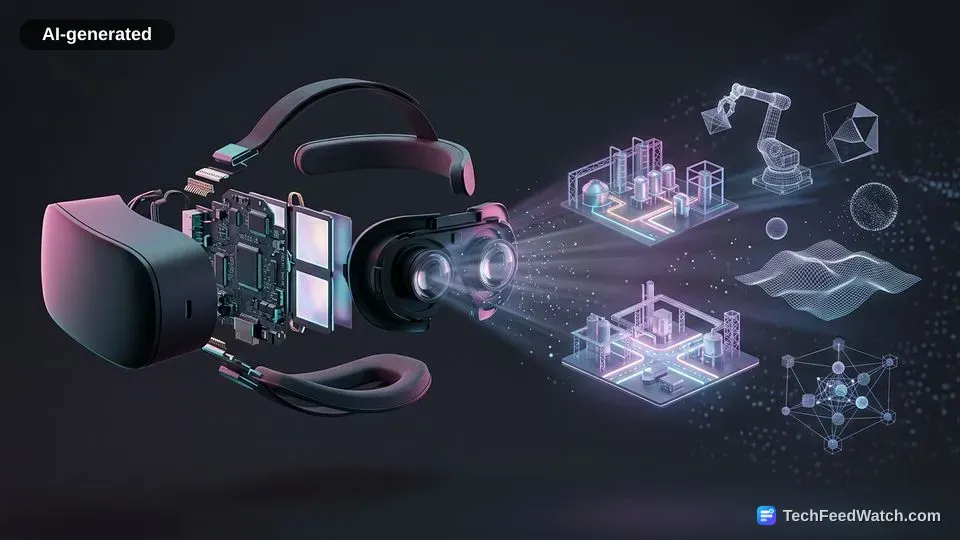
Headset engineering requires tradeoffs between wearable mass, graphical compute power, and physical cords. Standalone headsets house the processor, battery, internal memory, and tracking cameras directly on the frame. This architecture gives users unrestricted physical mobility at the cost of processing constraints and battery life.
Tethered headsets offload computing and electrical loads to dedicated desktop computers or video game consoles via physical DisplayPort or USB cables. A tethered unit delivers uncompressed visuals and sustained performance without thermal throttling, but the physical cable restricts physical movement. Some ultralight designs omit inside-out cameras entirely, relying on external room-scale laser tracking stations instead.
Mixed reality headsets differ from purely virtual reality hardware by integrating outward-facing passthrough cameras and depth sensors directly into their frames. While standalone and tethered headsets completely occlude the user’s field of view to show fully synthetic environments, mixed reality devices capture the surrounding physical environment and overlay digital content onto the live feed in real time.
According to Counterpoint Research’s global XR report published in September 2026, Meta led global AR and VR headset shipments in Q1 2026 with a 54% market share. Sony followed at 7%, while RayNeo, Pico, and VITURE held 6% each.
While accessible all-in-one headsets dominate unit volume, high-end enterprise niches continue to rely on specialized wired designs to evaluate complex 3D assets. Learn more about how designs differ by reading about whether virtual reality goggles replace heavy headsets over time.
Where are VR headsets used outside of video gaming?
Industrial and medical organizations deploy virtual reality hardware for complex spatial workflows where physical presence is cost-prohibitive or hazardous. While consumer hardware sales experience market cycles, professional usage exhibits structural growth.
According to Counterpoint Research, global VR headset shipments fell by 18% year-over-year in Q2 2026. Meanwhile, enterprise and government adoption for remote robotics operation and digital twin simulation demonstrated resilient demand.
Engineers use head-mounted displays to interact directly with digital twins of factory lines, power plants, and aerospace components before physical assembly begins. Operators control hazardous machinery from thousands of miles away by linking stereoscopic camera feeds directly into low-latency headsets.
Medical institutions rely on VR hardware for clinical training, surgical rehearsals, and diagnostic simulations. Trainees handle anatomical structures and rare surgical scenarios without patient risk. Similar tactical advantages apply to defense and commercial flight simulation, where pilots log thousands of procedural hours inside cockpit recreations.
Cybersickness and eye strain remain major health and safety concerns
Head-mounted displays produce physiological side effects when visual sensory input conflicts with internal vestibular balance cues. Your eyes may perceive rapid forward acceleration inside a virtual environment while inner ear fluid remains stationary. This sensory mismatch triggers motion sickness symptoms.
According to the IEEE Technology Navigator, cybersickness symptoms—including nausea, dizziness, and disorientation—affect between 20% and 95% of VR users. The exact rate depends on the application, individual vestibular sensitivity, and exposure duration.
A clinical education study published in Advances in Simulation in June 2025 followed 91 healthcare practitioners in VR psychiatric simulations. Participants in high-movement scenarios reported significantly more nausea than those in low-movement scenarios (p = 0.0275), and their overall cybersickness scores were higher too (a mean of 4.59 versus 3.10 out of 48).
Headset use also creates post-session physical disruptions and visual fatigue:
- Reduced blink rates dry out the corneal surface during intense sessions.
- Accommodation-vergence mismatches strain eye focusing muscles over prolonged viewing.
- Post-immersion vestibular disturbance causes temporary motor unsteadiness after removing the unit.
According to a United Kingdom government literature review published by the Health and Safety Executive on domestic VR systems, post-immersion effects can temporarily include impaired hand-eye coordination, reduced depth perception, and slowed reaction times. These complications stem from sensory conflicts between visual and vestibular balance systems. However, these complications do not cause permanent optical harm.
According to the American Academy of Ophthalmology in an advisory published in August 2024, staring into VR headset displays causes temporary digital eye strain and dry eyes due to infrequent blinking. You can evaluate display physiology further by checking if virtual reality glasses trick human senses effectively.
Gadget Ten compares high-end VR headsets and display specs
The creator highlighted the stark fragmentation across the hardware category: “You can spend $3,500 on one of the most advanced headsets ever made, and still end up with something that makes less sense for gaming than a headset costing a fraction of that.” According to Gadget Ten, “That pretty much explains VR in 2026.”
On the visual extreme, Gadget Ten evaluated the Pimax Crystal Super, priced at $1,599 (reduced from its previous $1,799 price). Its dual QLED displays provide 3840 x 3840 resolution per eye alongside Mini-LED local illumination, gaze tracking, and dynamic foveated rendering.
Gadget Ten noted that the 57 PPD version prioritizes pixel density, while the 50 PPD configuration expands the horizontal field of view. The creator explained that this extreme resolution makes sense for flight simulation and sim racing. In those titles, reading fine cockpit instruments and identifying distant track markers is essential.
Gadget Ten contrasted this bulky visual powerhouse with the Bigscreen Beyond 2, a PC-tethered headset weighing just 107 g. Bigscreen achieves this form factor by omitting internal computing boards, tracking cameras, and onboard batteries.
The unit features dual Micro-OLED displays delivering 2560 x 2560 pixels per eye across a 116° diagonal field of view. However, Gadget Ten pointed out that its $959 retail price does not represent a complete setup. Users must separately purchase SteamVR Lighthouse base stations and compatible controllers.
The comparison also examined mass-market alternatives across distinct ecosystems:
- Apple Vision Pro features an M5 chip, R1 sensor processor, 120Hz refresh rates, and 23 million pixels across dual Micro-OLED panels for $3,499.
- Sony PSVR2 provides 2000 x 2040 pixels per eye on OLED screens with a 110° field of view and Sense controllers for $400. Using it requires a PlayStation 5 or a $60 PC adapter.
- Meta Quest 3 runs standalone on a Snapdragon XR2 Gen 2 processor with pancake optics and Touch Plus controllers at $599.99 for the 512GB version.
Hardware selection comes down to balancing raw resolution against physical weight, ecosystem boundaries, and platform cost.