Sensors and Cameras That Track Degrees of Freedom
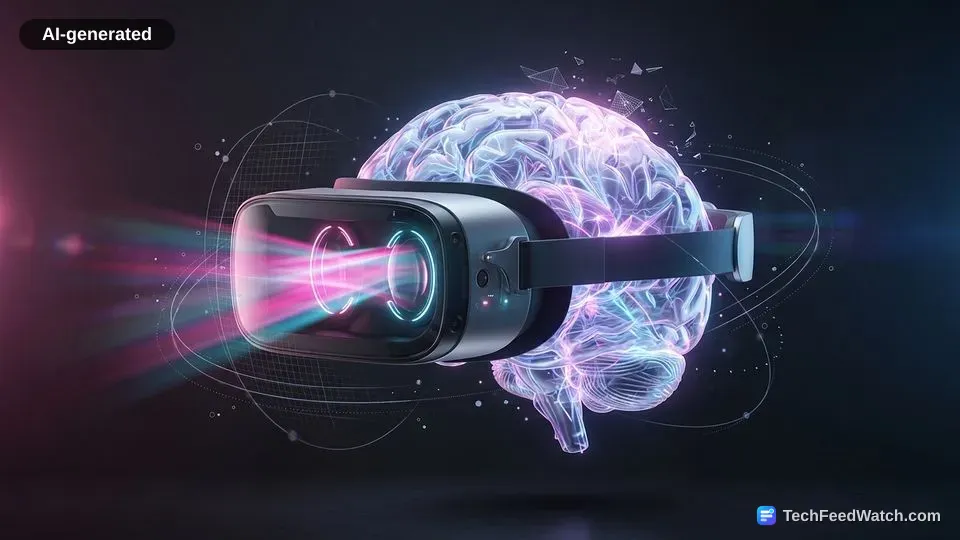
Visual immersion collapses if the displayed environment remains locked to the user’s face during movement. The headset must calculate the orientation and location of the head continually to adjust the scene perspective. Tracking architectures generally fall into two categories: three degrees of freedom (3DoF) and six degrees of freedom (6DoF).
Rotational tracking covers 3DoF, measuring pitch, yaw, and roll. Internal micro-electromechanical chips called inertial measurement units (IMUs) handle these rotations.
IMUs house solid-state gyroscopes and accelerometers that sample movement data thousands of times every second. These sensors detect sudden rotational changes instantly, updating the viewing angle within the digital world.
Full spatial immersion requires 6DoF, which adds translational movement along the X, Y, and Z axes. Positional tracking registers when a person takes a step, squats, or leans:
- Inside-out optical tracking systems rely on wide-angle external cameras embedded in the headset chassis.
- The onboard vision processors identify high-contrast visual features, edges, and objects within the room.
- Simultaneous Localization and Mapping (SLAM) routines calculate how those physical anchor points shift across the camera frames over time.
- The system determines precise physical movement and mirrors the displacement inside the virtual environment.
Understanding these tracking paradigms is essential when evaluating the best virtual reality goggles and why weight matters most for comfort and spatial stability.
Why Low Motion-to-Photon Latency Prevents Cybersickness
Motion-to-photon latency measures the exact time between a user moving their head and the corresponding visual frame illuminating on the headset display. When an individual turns their neck, the vestibular system inside the inner ear senses the acceleration instantly. If visual confirmation lags behind vestibular cues, the sensory mismatch triggers disorientation and motion sickness.
Hardware and software engineers must keep that delay imperceptible to the human nervous system. According to enterprise display manufacturer Varjo, maintaining motion-to-photon latency below 20 milliseconds is necessary because larger delays cause the human brain to detect disconnects between vestibular signals and visual input, causing spatial disorientation.
Achieving this benchmark requires high display refresh rates, such as 90 or 120 frames per second, coupled with aggressive rendering pipelines.
According to an experimental study published in the IEEE Picture Coding Symposium proceedings, the human perceptual threshold for motion-to-photon latency is approximately 23 milliseconds during rapid head turns at maximum human velocity and rises to roughly 41 milliseconds at an angular speed of 20 degrees per second. When rotational speeds peak, the human nervous system becomes extraordinarily sensitive to display lag.
Processing hardware struggles to hit absolute zero latency due to graphics rendering bottlenecks. According to a sensorimotor research study published in PubMed in October 2023 by researchers at the University of Leeds, hardware tests on the HTC Vive, Oculus Rift, Oculus Rift S, and Valve Index recorded initial sudden movement latencies between 21 and 42 milliseconds, which internal prediction algorithms reduced to 2 to 13 milliseconds within 25 to 58 milliseconds of movement.
Headsets employ predictive time-warping algorithms that recalculate and rotate the finished frame right before the screen updates, offsetting latency spikes.
Vergence-Accommodation Conflicts and Optical Hardware Limitations
The most prominent physiological hurdle across contemporary head-mounted displays is the vergence-accommodation conflict.
In natural vision, accommodation and vergence work in harmony. Accommodation describes the physical adjustment of the eye’s ciliary muscles to focus the lens on near or distant targets.
Vergence describes the inward or outward rotation of both eyeballs to center a single target onto the retinas. Looking at a finger near your nose forces both pupils to turn inward (vergence) while the ocular lenses reshape to focus close (accommodation).
Virtual reality optics break this biological link. The convex lenses fix the physical focal distance to a stationary virtual plane, usually one to two meters away. While the user’s eyes must accommodate permanently to that fixed focal distance, the stereoscopic images force the eyes to converge or diverge on digital objects rendered inches away or miles off.
According to a vision research paper published in the Journal of Vision in September 2024, the vergence-accommodation conflict occurs in virtual reality because the eyes accommodate to a fixed screen distance while converging on simulated 3D coordinates, causing a constant vergence offset that distorts perceived distances.
According to developer documentation published by Magic Leap, the physiological decoupling between ocular accommodation and vergence in near-eye displays represents a major cause of visual fatigue and cybersickness across extended reality hardware.
Researchers continue studying varifocal lens designs to resolve this fundamental physiological gap. Comparing these displays to transparent optical devices reveals why engineers evaluate the difference between virtual reality and XR glasses differently.
Flinch Lab Explains VR Lenses, Head Tracking, and Latency
The video demonstrates human physiological boundaries by noting that holding a standard smartphone display just one inch away from the eyeballs results in an illegible blur. Flinch Lab explains that headsets counter this by placing convex lenses between the eyes and the digital screen to bend light outward, effectively tricking the human visual system into relaxing as if the target were sitting several feet away.
The analysis highlights inside-out tracking, where onboard cameras scan the room for high-contrast tracking targets, such as the corner of a coffee table, a picture frame on a wall, or the edge of a rug. By monitoring how these physical landmarks shift, the headset anchors the user in three-dimensional space, supporting 6DoF movement like crouching and leaning.
Flinch Lab notes that a standard movie runs at 24 frames per second and a typical console video game operates at 60 frames per second. In contrast, a virtual reality headset must deliver 90 or 120 frames per second.
Flinch Lab explains that pushing total motion-to-photon latency to less than 20 milliseconds avoids vestibular panic, as the brain otherwise interprets sensory mismatches as the ingestion of toxins, initiating severe nausea.