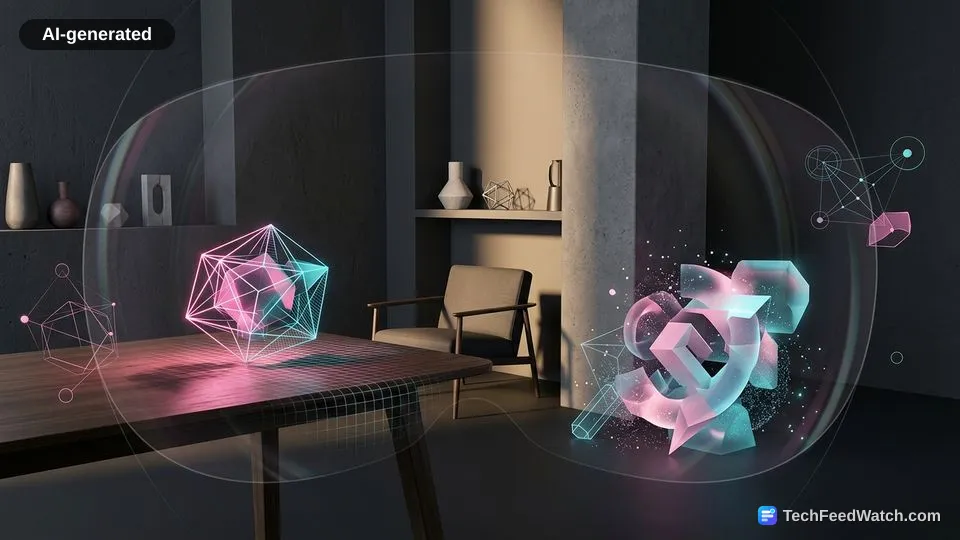
Optical see-through vs video pass-through headsets
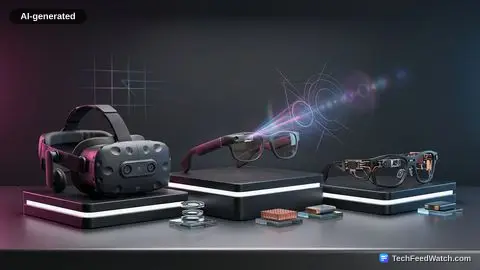
Optical see-through looks like faint, holographic light projected over direct human vision. In comparison, video pass-through looks like a digitized video feed of your room displaying solid, opaque computer models.
According to Varjo’s display technology guide, optical see-through displays project additive light through transparent lenses. These displays cannot display the color black, causing digital objects to look semi-translucent.
Because additive light cannot subtract real photons entering the eye, bright physical lighting bleeds through virtual objects. Wearers see digital forms as glowing, ghostly projections floating within their direct line of sight.
Video see-through operates through completely opaque display panels paired with outward-facing cameras. Varjo’s display technology guide notes that video see-through displays render true black and fully solid virtual objects. This allows digital items to block out physical objects behind them completely.
The resulting visual presentation creates distinct trade-offs for wearers:
- Optical see-through provides pristine, unmediated human vision of the room with zero camera latency.
- Optical see-through struggles in daylight, where solar brightness washes out the semi-transparent holographic graphics.
- Video pass-through provides dense, visually solid objects with dynamic drop shadows and true black tones.
- Video pass-through presents the room as an electronic video stream, lowering contrast and dynamic range compared to natural vision.
Digital objects interact with physical surfaces and real lighting
Digital objects visually interact with physical environments by casting synthetic shadows onto real floors. They also reflect room light and disappear behind physical obstacles when viewed from different angles.
According to Microsoft Learn’s mixed reality documentation, headsets visually blend physical and digital worlds along the reality-virtuality continuum. They use spatial mapping, surface recognition, and ambient lighting to anchor digital content into a user’s physical surroundings. Sensors map walls, flat tables, and ceiling boundaries into a coordinate grid.
Software calculates where ambient light sources sit in the room, creating simulated shadows under digital assets. A virtual bronze statue placed near a lamp shows realistic highlights on the illuminated side and darker tones on the reverse.
According to Meta Horizon OS Developer documentation, visual realism relies on Scene Mesh, Depth APIs, and spatial anchors. These features enable virtual assets to dynamically occlude behind real furniture and collide with physical geometry.
These developments in spatial systems and interaction ensure virtual characters hide behind couches rather than clipping through them. If a virtual ball drops from a table, it bounces off the physical hardwood floor rather than dropping endlessly through space.
Physical occlusion provides the primary visual cue that convinces the human brain that an object exists in physical space. When a user reaches out their real hand, the headset software calculates hand depth relative to the virtual asset. The hand appears directly in front of the model, hiding the digital pixels behind the skin.
What visual flaws and distortions appear inside the headset?
Inside a mixed reality headset, users see camera noise in dim light and geometric warping around moving hands. They also notice pixelation from display resolution limits and subtle depth perspective mismatches.
No current hardware achieves a flawless visual match with unassisted human sight. A January 2026 study by Jialin Wang and colleagues, posted on arXiv, found that video see-through technology still introduces measurable visual distortion.
It also creates perceptual depth mismatch and higher cognitive task loads compared to direct human vision. Users reaching for physical cups or door handles often misjudge distance due to slight optical discrepancies. The visual feed can trigger subtle discomfort when eye movements outpace the rendering pipeline.
Sensors and optics create distinct visual artifacts that wearers notice immediately:
- Image grain and motion blur emerge across the video feed in low-light environments.
- Dynamic warping ripples around moving limbs when software calculates hand boundaries against background feeds.
- Peripheral distortion curves straight lines along the edges of the display lenses.
- Focus disparity occurs because the human eye focuses on a fixed focal display panel while looking at objects positioned at varying digital depths.
According to that study, video pass-through headsets alter human visual perception. This occurs due to fixed display focal distances, camera sensor grain in low light, and perspective parallax caused by external cameras being displaced from the user’s actual eye positions.
Because camera lenses sit a few inches ahead of or wider than the user’s biological pupils, the brain receives a perspective slightly offset from natural sight.
BMFVR reveals how Quest 3 games transform physical rooms
BMFVR demonstrates that mixed reality on the Quest 3 transforms standard living rooms into digital battlefields, alien caverns, and cyber environments. It achieves this through spatial scanning and room-scale environmental portals.
In an analysis of modern titles, BMFVR stated, “Mixed reality might be one of the most underutilized or at least underappreciated aspects of the Quest 3.”
Examining recent software releases, BMFVR highlighted Into the Dead: Crimson Heights as a game built on real-world scans to create walkable hyper-reality environments. The analysis emphasizes that mixed reality succeeds when it actively adapts to unique household layouts rather than demanding an empty room.
BMFVR tested several games that illustrate how software alters physical rooms:
- A horror experience called Underline scans multiple rooms to overlay cavernous underworld textures reminiscent of the Stranger Things Upside Down. It also applies softened dynamic occlusion to disguise the user’s hands.
- Exploit Zero covers the room in Tron-style digital grids. In this game, incoming hacking viruses progressively glitch and digitize floors and furniture until a total system game over occurs.
- Starfall presents a 25-minute story-driven experience. In this title, players step through virtual portals into space stations and look backward into their physical living room.
- Reality Guard converts furniture layouts into defensive structures for local co-op and competitive magic battles.
BMFVR pointed out that the most striking visual trick in mixed reality involves stepping through a doorway into a virtual field. The user can then turn around to view their real room framed within the portal.