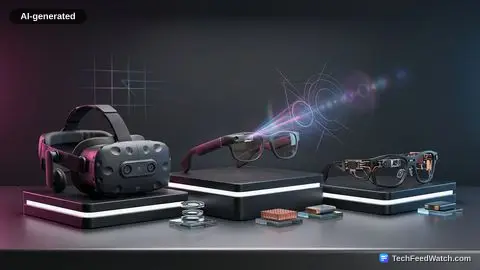
Stereoscopic displays and lenses create simulated 3D depth
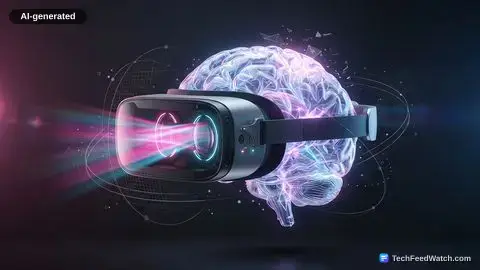
Virtual reality goggles create depth perception by showing two offset two-dimensional images through specialized optical lenses. The brain then combines these views into a single three-dimensional image.
Specialized pancake or Fresnel lenses adjust the focal length across wide fields of view. Display panels sit mere inches from the human face, making direct focal accommodation impossible without optical assistance.
Specially shaped lenses bend display light and redirect incoming rays. This allows the human eye to relax and focus as if viewing an object situated meters into the distance.
Optical assemblies generally depend on one of two primary lens architectures:
- Fresnel lenses incorporate concentric rings to focus light while shedding bulk, though they occasionally introduce internal glare and visible ring reflections.
- Pancake lenses bounce light between polarized surfaces to fold optical paths, producing thinner visors while sacrificing higher percentages of panel brightness.
- Dual high-density display panels sit aligned behind these lenses, projecting dedicated pixel arrays calibrated to individual pupil positioning.
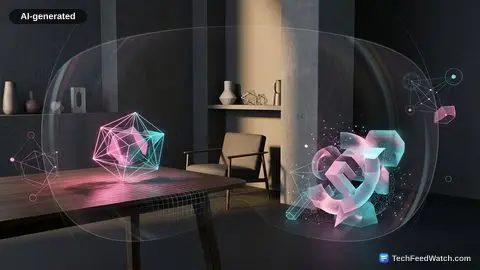
These optical designs recreate natural binocular disparity. Because human eyes are horizontally separated, each retina registers physical scenes from a fractionally different vantage point. Virtual reality goggles digitally calculate this precise perspective shift for every frame rendered, delivering convincing stereoscopic depth across simulated terrain.
What hardware tracks your head and body movements?
Virtual reality goggles track user movement using integrated optical cameras, inertial measurement units, and computer vision algorithms. These systems calculate physical position across six degrees of freedom.
According to the Institute of Electrical and Electronics Engineers (IEEE), modern VR systems employ six degrees of freedom (6DoF) tracking. This technology measures rotational axes (pitch, yaw, and roll) alongside translational positions to prevent sensory lag and motion sickness caused by unsynchronized movement.
Basic rotational tracking registers head rotation on stationary axes, but cannot account for ducking, stepping forward, or leaning sideways. True 6DoF capability bridges that gap, continuously updating display graphics to mirror spatial shifts down to millimeter tolerances.
Modern tracking hardware coordinates several physical inputs simultaneously:
- Inertial measurement units combine micro-electromechanical gyroscopes and accelerometers to measure rotational changes thousands of times per second.
- External-facing camera arrays scan the surroundings to perform simultaneous localization and mapping across physical walls and floors.
- Optical and infrared sensors monitor hand poses or dedicated controllers to reproduce limb articulation inside the simulation.
- Voice-recognition microphones process direct audio commands to control software interfaces hands-free during intensive drills.
Reliable tracking demands exceptionally low latency from sensor capture to panel refresh. If physical motion takes longer than a few milliseconds to reflect on screen, the human sensory system detects the desynchronization immediately.
Sensory mismatches cause cybersickness and eye strain
Cybersickness and eye strain occur when simulated visual motion contradicts inner ear balance signals. They also happen when hardware forces the eyes to focus against natural optical depth cues.
According to research published by the National Institutes of Health (PMC) in November 2024, wearing a head-mounted display can cause vergence-accommodation conflict (VAC). This mismatch occurs when the eyes converge at simulated depths while accommodating to a fixed optical screen distance, triggering headaches, oculomotor fatigue, and disorientation.
In normal human vision, ocular convergence angles and lens accommodation focus concurrently at identical distances. Inside a headset, the panel remains at a fixed optical distance. This forces eye muscles to hold focus on flat glass even while converging inward on virtual objects that appear nearby.
Cybersickness creates a severe physiological bottleneck for extended use. According to a systematic review published by the National Institutes of Health (PMC), cybersickness remains a significant limitation of VR adoption.
The visual field may move rapidly down a digital corridor while the inner ear registers zero physical acceleration. In this scenario, the brain registers the conflicting inputs as a physiological crisis.
Software techniques such as dynamically restricting a user’s peripheral field of view during simulated locomotion significantly reduce motion sickness symptoms during extended sessions. Hardware designers also focus heavily on reducing physical facial load to mitigate muscle strain, maintaining an engineering balance critical for the best virtual reality goggles.
Tech Court breaks down Meta’s lightweight split-design VR glasses
Tech Court reports that Meta has separated display optics from core computing hardware to dramatically reduce facial weight in its upcoming VR glasses.
During its Connect 2026 conference, Meta revealed hardware that moves the processor, battery, and storage away from the headset into an external compute puck. According to Tech Court, this split layout leaves glasses weighing around 100 grams on the user’s face.
Meanwhile, a separate 300 grams moves into a pocket or onto a belt. The offloaded compute puck houses Qualcomm’s Snapdragon Reality Elite platform, connecting to the frames through a dedicated optical tether.
Tech Court explains that the glasses incorporate twin Micro-OLED screens. These displays provide 2412 by 2288 pixels for each eye at refresh capabilities reaching 120 hertz.
Meta terms this its 5K infinite display, yielding around 37 pixels per degree to enable legible document text. Tech Court reports that the design accepts an optical compromise, narrowing visual coverage to approximately 70 degrees across and 66 degrees up and down.
Tech Court notes the device provides IMAX Enhanced playback certification and partnerships for more than 100 live annual sports broadcasts. It also offers launch support for more than 75 games featuring hand-only controls alongside handheld controllers called Touch Plus. Users can project multi-display workstation desktops or generate real-time photorealistic call avatars.
According to Tech Court, Meta scheduled launch for spring 2027 at $1,299.99 with up to around 3 hours of continuous playback. Meanwhile, rival hardware maker XREAL targets fall 2026 for its competing Aura device at a price ceiling of no more than $1,500.