
Optical lenses overlay light while video pass-through encloses vision
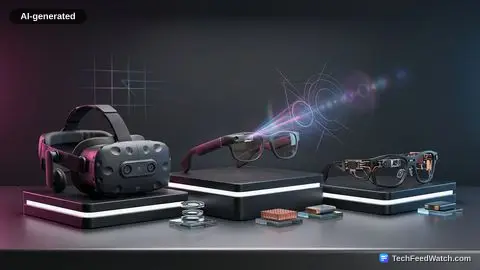
Optical see-through hardware projects transparent light over your direct vision, whereas video pass-through hardware captures the room with cameras and digitizes the entire scene before showing it on internal screens.
Optical see-through hardware relies on transparent glass waveguides. According to Microsoft Learn, the HoloLens 2 headset projects digital holograms into the user’s eyes using transparent waveguide lenses and 2K 3:2 light engines.
Wearers view the real world through clear glass while glowing digital light paints interfaces across the room. Because projectors cannot beam darkness, virtual items on optical see-through displays appear slightly luminous or translucent against bright backgrounds.
Video pass-through takes an opaque display approach that changes what mixed reality looks like in practice. According to official Apple specifications, the Apple Vision Pro creates video pass-through using a 23-million-pixel micro-OLED display system paired with an Apple R1 chip that processes camera feeds at a 12-millisecond photon-to-photon latency.
The user does not see the physical room directly. Instead, external cameras film the environment and recreate it on tiny digital monitors sitting millimeters from the eyes.
According to the Augmented Reality Enterprise Alliance, these two optical methods produce distinct visual trade-offs:
- Optical see-through maintains full peripheral vision and shows the real environment with zero camera distortion.
- Optical see-through displays cannot render true black, making dark virtual elements look semi-transparent.
- Video pass-through delivers solid, fully opaque digital objects that completely block background light.
- Video pass-through restricts peripheral vision to an artificial display field of view between 90 and 120 degrees, according to the Augmented Reality Enterprise Alliance.
How do digital objects anchor onto physical surfaces?
Digital objects lock into place using spatial tracking algorithms and computer vision that calculate surface planes and device position.
According to Dassault Systèmes, augmented reality software uses Simultaneous Localization and Mapping alongside computer vision to track physical features. These algorithms calculate the exact distance between the camera lens and surrounding surfaces. This tracking anchors digital models to tables, floors, and walls with centimeter-level precision as the user walks around, according to Dassault Systèmes.
When tracking algorithms detect a table, the graphics engine draws artificial shadows directly beneath the virtual item. If a person places a physical mug in front of the digital object, advanced software cuts the virtual pixels away so the physical mug occludes the graphic.
Poor lighting or featureless white walls cause digital objects to jitter, drift across the floor, or sink through solid surfaces. Stable visual anchoring depends on high-contrast physical details in the room.
Focal strain and narrow fields of view limit realism
Narrow optical windows and fixed display focus create visual limits that remind the viewer they are looking at artificial images.
According to research from the University of Reading’s Department of Typography and Graphic Communication, optical augmented reality displays cause eye strain due to the vergence-accommodation conflict. In the physical world, your eyes turn inward and adjust lens shape to focus on objects at specific distances.
Headset optics place displays at a fixed focal distance, forcing eyes to rotate for 3D depth while focusing on a flat optical plane, according to the University of Reading researchers.
While human eyes cover broad horizontal vision, consumer augmented reality glasses project imagery across a narrow rectangular box in the center of your sight. If you look slightly away from a virtual object, the edge of the optical display clips the item in half until you turn your head toward it again.
Bright sunlight overpowers the miniature projectors inside optical glasses, washing out digital colors and turning solid interfaces into faint ghosts.
Cas and Chary XR tests lightweight Snap and XREAL glasses
Cas and Chary XR tested several next-generation head-worn devices to evaluate how modern hardware renders augmented graphics in compact form factors.
According to Cas and Chary XR, Snap Specs feature a 51-degree diagonal field of view, weigh 132 grams, and operate with a motion-to-photon latency of 7 milliseconds. Snap prices the standalone glasses at $2,195, according to Cas and Chary XR.
The channel observed contextual graphics on Snap Specs, including a demonstration where arrows pinpointed where to pour coolant inside a car engine. While the thin waveguides fit into a wearable form factor, Cas noted that the demo graphics can appear rough compared to bulky headsets.
Cas and Chary XR also tested the tethered XREAL Aura glasses, which move computing hardware to an external puck. According to the creator, the glasses weigh 95 grams, offer a 70-degree field of view, run up to 120 Hz on dual Sony micro-OLED displays, and draw power from Qualcomm’s Snapdragon Reality Elite processor with 48 TOPS of AI compute.
Cas noted that separating compute hardware allows glasses to deliver wider visual fields and sharper pixels without overburdening the wearer’s face.