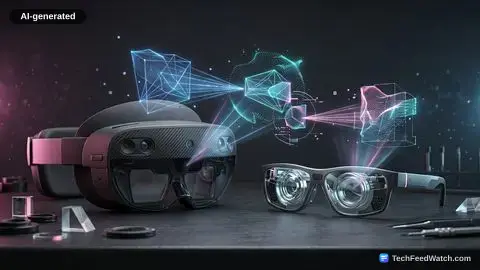

Display engineering and optical specs behind modern AR glasses
The visual engine forms the core of any augmented reality wearable. Higher field-of-view metrics expand the visual canvas, preventing the boxed-in sensation that plagued earlier smart eyewear. For years, consumer AR glasses hovered around a 46 degrees field of view.
Recent optical breakthroughs push that limit further. The RayNeo GT Max hits a 59 degree field of view, outstripping competitors like the Viture Beast at $549, and the XREAL One Pro at $599 for 57 degrees.
Optical construction determines picture clarity and physical frame aesthetics. Traditional birdbath optics route light through angled beam splitters, often reflecting the user’s face or lower environment back into their vision.
Modern rectangular optics, similar to X-Prism design, project light straight through the glass lens. Historically, accessing rectangular prism optics required spending $600 or more. Bringing this optical standard down to a $399 price point changes the manufacturing baseline across the entire industry.
Display panel specifications back up these optical gains. High-end AR wearables deploy Micro-OLED panels running at 120Hz refresh rates.
Resolution sits at 1920x1080 per eye in 2D mode and expands to 3840x1080 in 3D mode, maintaining a visual sharpness of 38 PPD. Peak brightness reaches 1200 nits, allowing visibility under indoor lighting or shaded outdoor environments.
Onboard silicon handles real-time color processing. The Vision 4000 display chip, co-developed with Pixelworks, uses real-time AI processing to execute SDR to HDR conversion.
The display architecture yields a 200,000 to 1 contrast ratio, 145% sRGB coverage, and 98% DCI-P3 color gamut coverage, keeping color accuracy under a delta E of less than 2. Users can adjust display settings for extended wear, including switching to Eye Care mode to significantly reduce eye fatigue during long sessions.
AR glasses optical comparison:
| Device model | Field of view | Market price |
|---|---|---|
| RayNeo GT Max | 59 degrees | $399 |
| Viture Beast | Not listed | $549 |
| XREAL One Pro | 57 degrees | $599 |
| Legacy AR glasses | 46 degrees | Not listed |
How spatial tracking transforms AR glasses into productivity tools
High visual fidelity transforms AR glasses from entertainment gadgets into functional productivity tools. Users can connect their laptops, mirror their screens, and dim physical monitors completely to work on private documents in public spaces. A 267 inch virtual display creates ample digital screen real estate, letting users position full-scale windows floating in mid-air.
Spatial position tracking makes extended productivity feasible. Simple head-worn screens that follow every head twitch cause neck strain and motion discomfort. Modern 3DoF tracking solves this through three distinct display behaviors:
- Follow Mode: The traditional follow mode standard on budget AR glasses that follows head movement directly.
- Steady Mode: Software dampens movement so the screen smoothly follows head turns like a gimbal attached to your head.
- Pinned Screen Mode: The virtual screen anchors to a fixed spatial coordinate, allowing users to set it in one place, look around at physical surroundings, and look back with the display locked in place.
Spatial stabilization relies on internal sensors that process motion in real time. Understanding What SLAM Means for Anchoring Augmented Reality Objects illuminates how position tracking locks digital overlays to physical rooms.
Audio hardware plays an equally critical role in spatial immersion. Integrated acoustic designs use Bang & Olufsen co-tuned racetrack quad speakers built directly into the frame arms. A 5dB boost in low-frequency sensitivity adds a deeper, more intense bass response compared to standard acoustic drivers.
Head-tracking spatial audio dynamically repositions sound channels based on head orientation. In racing or action software, an approaching vehicle engine sounds distinctly behind or beside the user as they turn their head, producing an accurate 3D soundscape without forcing the user to wear separate headphones.
What Others Missed
While hardware specs continue to advance rapidly, software ecosystem parity remains an industry bottleneck. Dedicated utility apps allow users to spawn multiple virtual monitors side-by-side on desktop operating systems. However, platform support remains uneven.
While Windows operating systems frequently receive multi-screen utility applications, macOS support lags behind on select hardware lines. Mac users connecting to glasses without dedicated desktop software must rely on single-screen display mirroring or split laptop-and-overhead virtual screens.
Power delivery and hardware design trade-offs also persist across modern AR glasses. Very few lightweight frames feature built-in battery cells due to strict weight limits. Devices must draw power and video signals continuously through a USB-C display cable connected to a host device like a smartphone, console, or laptop.
While high-end models ship with prescription lens inserts, adjustable nose pads, and adhesive face cushion pads, features like electrochromic dimming—which electronically darkens the outer glass lens—are sometimes omitted to meet lower price targets. Wearers in bright sunlight must use physical snap-on light shields instead.
As Steven Sullivan points out, acquiring rectangular prism optics previously demanded a $600 outlay, making a $399 price point a fundamental market disruption. Delivering high-spec display engines and spatial audio at $399 fundamentally alters buyer expectations across the smart glasses sector.
What Is the Best Augmented Reality Glasses Option Today
To declare what is the best augmented reality glasses option, buyers must balance display size, spatial motion control, audio performance, and purchase price. No single device excels in every edge case, but high optical performance at a competitive cost defines the current top tier.
Two ways to choose:
- High-spec value focus: 59 degree field of view, $399 retail price, rectangular prism optics, Bang & Olufsen audio.
- Ecosystem focus: native multi-screen Mac apps, electrochromic lens dimming, a $549 - $599 price point, higher accessories cost.
Devices like the RayNeo GT Max represent the strongest overall balance for consumer display glasses. Offering a maximum 59 degree field of view, 120Hz refresh rate, AI-driven color enhancement, 3DoF tracking modes, and Bang & Olufsen audio for $399, it provides specs that exceed devices costing $150 to $200 more.
Competitors such as the XREAL One Pro ($599) or Viture Beast ($549) offer strong software app integration and alternative optical builds, but they require a significantly larger financial investment for narrower field-of-view metrics.
For users exploring the broader distinctions between display types, evaluating the What Are the Fundamental Differences Between AR and VR? helps clarify why lightweight video-passthrough glasses serve personal viewing and mobile productivity better than bulky VR headsets.
Additional features like 2D to 3D video conversion add extra value for media consumption. Testing 2D to 3D mode on YouTube with POV BASE jumping off of a skyscraper at night demonstrates real visual depth added to flat video files.
When paired with modular accessories like the Pocket TV—a handheld remote running Google TV—or directional SoundTubes for enhanced privacy, consumer AR glasses operate as fully realized personal theater systems.
Why modern AR glasses are viable everyday screen replacements
The market shift toward wide-FOV, low-cost AR glasses is a permanent transition. High-refresh Micro-OLED displays, spatial audio drivers, and stable 3DoF tracking have officially transitioned from expensive enterprise experiments to accessible consumer hardware.
Devices that deliver a 59 degree field of view and premium optics at $399 prove that immersive spatial displays can be lightweight, highly functional, and affordable. Modern AR glasses are no longer niche display adapters—they are practical, portable screen replacements ready for everyday use.