
How the Best Mixed Reality Headset Changes Spatial Work

Researched with a video published on YouTube by TechVisions. TechFeedWatch is not affiliated with the creator, and all rights to the video remain theirs.

Identifying the best mixed reality headset requires balancing visual fidelity, processing architectures, and price. While the Meta Quest 3 stands as the premier all-around consumer device, Samsung's Galaxy XR pushes display hardware into professional workstation territory. This guide examines how optics, spatial compute platforms, and tracking hardware define the current market.

The best mixed reality headset for general consumers is the Meta Quest 3, which pairs high-resolution pancake optics with accessible standalone spatial computing. For power users seeking desktop-grade immersion, the Samsung Galaxy XR establishes a new high-end benchmark through ultra-dense Micro-OLED panels and productivity-focused software.

What It Is: Finding the Best Mixed Reality Headset

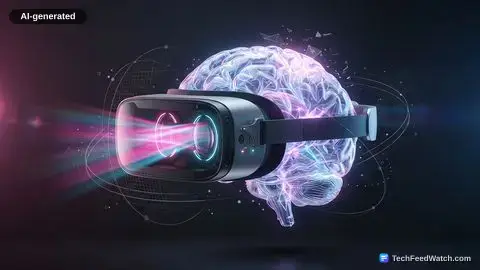
Mixed reality bridges physical surroundings with responsive digital content. Unlike dedicated virtual environments that isolate you completely, mixed reality relies on low-latency camera passthrough and depth calculation to position interactive 3D assets directly into your physical space.

Understanding the What Are the Fundamental Differences Between AR and VR? helps clarify why this category has exploded: instead of projecting tiny text onto transparent lenses, modern mixed reality captures your surroundings using camera sensors, digitizes the feed, and composites real-time digital elements onto ultra-sharp internal displays.

Choosing the right device requires assessing physical comfort, optical clarity, silicon efficiency, and ecosystem support. Meta established a dual-tier approach to capture both mainstream buyers and value seekers.

The flagship Meta Quest 3 delivers dual LCD panels running at 2064 x 2208 pixels per eye, representing a 30% improvement in clarity over the Quest 2. It pairs this visual jump with pancake lenses that eliminate optical distortion and compress the physical chassis.

At the budget boundary, the Meta Quest 3S enters the market at $299. It shares the same Snapdragon XR2 Gen 2 processor found in the Quest 3, ensuring identical application compatibility and mixed reality processing.

Meta kept costs down on the Quest 3S by using a single-panel LCD showing 1832x1920 per eye paired with older fresnel lenses. It proves that capable spatial computing no longer demands an exorbitant entry fee.

At the ultra-premium end sits the Samsung Galaxy XR. Built on Google’s newly developed Android XR operating system, this device targets spatial productivity rather than casual gaming alone.

It introduces dual Micro-OLED displays with a resolution of 3,552 by 3,840 pixels per eye, packing approximately 29 million pixels into the optical path. That degree of visual density eliminates the “screen-door effect” entirely, allowing users to read tiny system fonts without neck strain.

Dedicated gaming hardware occupies a separate lane. The PlayStation VR2 focuses strictly on tethered console performance.

It pairs with the PlayStation 5 to output 2,000 x 2,040 pixels per eye across high-dynamic-range OLED displays at refresh rates up to 120 Hz. While it lacks standalone portability, it drives visually complex titles like Horizon Call of the Mountain that mobile chips cannot render natively.

Watch: the video

6 min video by TechVisions.

How It Works

Mixed reality headsets combine three mechanical pillars: optical projection, spatial tracking arrays, and distributed computing silicon.

First, display physics dictate usability. Traditional headsets relied on thick, grooved fresnel lenses that forced light through heavy glass stacks, creating glare rings and sweet-spot degradation. Modern hardware increasingly favors pancake optics or direct Micro-OLED configurations.

In the Galaxy XR, those 29 million pixels span a field of view measuring 109° horizontal and 100° vertical, preserving peripheral vision and preventing the tunnel-vision sensation common on older hardware. By comparison, the PlayStation VR2 achieves an expansive 110° field of view through custom optics built around OLED micro-panels.

Second, tracking relies entirely on machine vision. Earlier virtual systems required external base stations mounted in room corners to pulse infrared light. Current platforms use inside-out tracking.

The Meta Quest 3 uses six cameras mounted across its front chassis, combining stereoscopic RGB passthrough sensors with infrared depth sensors to track room architecture, physical obstacles, and bare hands. PlayStation VR2 accomplishes spatial positioning via four built-in cameras, complementing its tracking with internal eye-tracking cameras that dynamically render full detail only where the human fovea focuses.

Third, dedicated mobile silicon handles the processing load without roasting the user’s face. The Snapdragon XR2 Gen 2 found in both the Quest 3 and Quest 3S integrates onboard computer vision blocks designed to eliminate motion-to-photon latency. High-end devices push thermal dissipation even further.

The Samsung Galaxy XR packs the upgraded Snapdragon XR2+ Gen 2 chipset alongside 16 GB of RAM and 256 GB of storage. As TechVisions points out, this hardware foundation allows the Galaxy XR to operate mixed reality floating window workflows, letting users position persistent monitors across a room while running voice processing directly through Gemini.

Hardware trade-offs remain persistent across every price point. Wireless standalone headsets like the Quest 3S run for approximately 2 hours on a single charge. The Galaxy XR provides 2 to 2.5 hours of uptime, and its panel refresh rate maxes out at 90 Hz to balance power draw against thermal thresholds.

To bypass battery constraints entirely, users can route the Quest lineup to a gaming desktop via Meta Link or Air Link, turning mobile hardware into a high-throughput PC display. The underlying mechanics of these interfaces illustrate Spatial Systems and What Mixed Reality Means for Interaction across physical spaces.

Headset Picks for Everyday Users, Professionals, and Gamers

Hardware needs split sharply along use cases:

  • The Mainstream Explorer: The Meta Quest 3 remains the default recommendation for users who want high-quality mixed reality without system compromises. Its pancake lenses, 8 GB of RAM, and full-color passthrough create an accessible platform for gaming, physical fitness, and lightweight spatial interfaces.
  • The Budget-Conscious Buyer: The Meta Quest 3S targets newcomers hesitant to spend heavily. For $299, users gain the identical Snapdragon XR2 Gen 2 gaming performance, inside-out tracking, and software catalog of the Quest 3, accepting lower screen resolution and thicker lenses in return for immense cost savings.
  • The Spatial Professional: The Samsung Galaxy XR caters to developers, creatives, and enterprise workers. With Android XR, Gemini integration, and 29 million pixels across dual Micro-OLED displays, it handles document editing, virtual workspaces, and multi-app multitasking that would blur on budget LCDs. Exploring What Premium Specs Mean for Best Augmented Reality Glasses reveals a similar push toward miniaturized, high-density microdisplays.
  • The Dedicated Console Gamer: The PlayStation VR2 fits console owners who prioritize rendering power over wireless portability. Its 120 Hz OLED panels, haptic feedback controllers, and direct PS5 connection deliver graphics that mobile chips cannot replicate.

Those who primarily want thin, transparent eyewear for basic notifications will find all these headsets too bulky. Mixed reality hardware prioritizes field of view, spatial compute, and immersive occlusion over pocketable frames.

Matching Headset Optics and Performance to Your Daily Workflow

Choosing the best mixed reality headset comes down to matching your intended workflow with optical requirements. Meta dominates the consumer field: the Quest 3S sets an unbeatable entry bar at $299, while the Quest 3 balances resolution, comfort, and standalone flexibility for everyday users.

If your work requires substituting physical computer monitors with pristine digital screens, high-end Micro-OLED hardware like the Samsung Galaxy XR justifies its premium tier. Define whether you need standalone agility, workstation-grade text clarity, or raw console processing before picking your headset.

Frequently Asked Questions

What is the best mixed reality headset for overall value?

The Meta Quest 3 offers the best balance of price and performance, providing high-resolution pancake lenses, color passthrough, and standalone operation without needing a PC.

How does the Samsung Galaxy XR compare to standard VR headsets?

The Galaxy XR delivers workstation-grade fidelity with dual Micro-OLED displays outputting approximately 29 million pixels alongside Google's Android XR platform and Gemini voice control.

Can budget headsets like the Meta Quest 3S handle true mixed reality?

Yes, the Meta Quest 3S features the Snapdragon XR2 Gen 2 chip and full mixed reality tracking at a entry-level $299 price point.

Why do some premium headsets still require a cable tether?

Console devices like the PlayStation VR2 prioritize uncompressed graphics processing directly from external hardware, trading wireless mobility for raw graphical output and 120 Hz refresh rates.

Jacob S. Olsen

Jacob S. Olsen

Runs TechFeedWatch, from Denmark

How this article was made: every article starts from two things — a question people search for on Google, and a video from an independent creator on that subject. A language model writes the article to answer the question, using the video's transcript as its research material. It publishes automatically — I do not read every article before it goes live. The creator is credited on this page.

What is mine is the machinery and the rules it follows: which subjects, which sources, what gets rejected, and what this site is allowed to claim. More on that here — and if something is wrong, tell me.