Optical Density Versus Field of View
When asking what makes a headset superior, buyers often look at field of view first. That metric is misleading in compact spatial goggles.
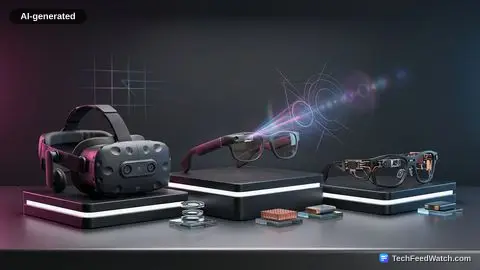
Traditional consumer headsets push for a wide field of view to simulate total immersion inside video games, but they sacrifice pixel concentration across the central viewing area. Compact goggles reverse that logic completely to prioritize reading text, working across spatial displays, and viewing high-resolution video.
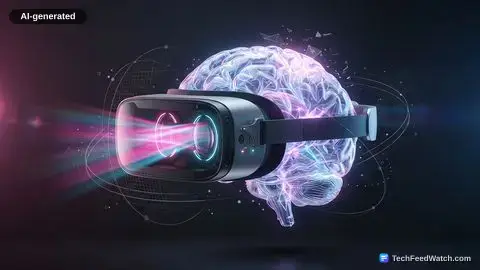
The optical engine inside Meta VR Glasses deploys twin Micro-OLED panels outputting 2412x2288 pixels per eye, marketing roughly 5,000 pixels across the horizontal expanse.
Paired with compact pancake lenses, the system creates an 84° diagonal field of view, which translates into 70° horizontal and 60° vertical. While that viewing window is visibly narrower than a standard Quest 3, the optical concentration leaps to 37 pixels per degree.
That pixel density crosses the threshold where text rendering appears paper-sharp rather than pixelated. The user interface applies a subtle “squircle” curve around the border of the display, framing content cleanly against real-world peripheral light. Because these goggles feature an open-periphery industrial design, users can see the physical room around the edges of the optics.
Rather than disorienting the wearer, this open design grounds spatial awareness and prevents the motion disconnect that causes nausea in closed visors. For users evaluating VR Headsets: Difference Between Virtual Reality and XR Glasses, this hybrid approach demonstrates how spatial hardware can fuse mixed reality overlays with physical presence.
Pass-through fidelity matches the display quality. The front sensor array provides 27 pixels per degree for color pass-through, rivaling high-end enterprise headsets. Unlike fixed-focus pass-through cameras, these optical sensors actively adjust their focal planes using internal eye tracking.
When you gaze at a smartphone in your hand, the cameras adjust focus dynamically to bring the nearby screen into crisp focus, then refocus outward when you look across the room. The optical stack also accommodates physical interpupillary adjustments, offering an IPD range of 62 mm to 71 mm across standard and large frame sizes to prevent chromatic aberration and visual distortion.
Software Ecosystem and Spatial Work Realities
Hardware specifications mean nothing if the software layer cannot handle real workflows. The best virtual reality goggles must manage spatial multitasking, entertainment streaming, and legacy input without demanding that users constantly hold plastic wand controllers.
The operating system bridges that gap. As Adam Savage’s Tested points out, “The the real advantage to Meta VR Glasses over the competitors is going to be its use of Horizon OS and that deep library of Quest content.”
Running a high-fidelity implementation of Horizon OS, Meta VR Glasses integrate hands-free gaze selection with pinch tracking. During early hands-on evaluations, the eye tracking calibration onboarding closely mirrors Apple’s approach:
- The display flashes a sequence of target dots
- The user taps their index finger and thumb while looking at each point
- The system locks in ocular calibration within seconds
Downward-facing rim cameras track hands resting naturally on a lap, while also capturing lower-facial movement. Combined with internal gaze tracking, this sensor array powers Meta’s photorealistic “Hologram” avatars—formerly developed under the Codec Avatars moniker.
Controller freedom defines the user experience, yet flexibility remains intact. The platform launches with 75 titles fully optimized for controller-free hand and gaze tracking, allowing users to chop blocks in Beat Saber using bare palms.
For complex gaming sessions, the goggles smoothly pair with standard Quest Touch Plus controllers, retaining access to established software libraries. The display engine operates at a baseline 90 fps, scaling smoothly to 96 fps for media partnerships and cinematic documentaries, with developer support reaching up to 120 fps for low-latency interactive applications.
Beyond entertainment, spatial productivity highlights How the Best Mixed Reality Headset Changes Spatial Work. The headset links directly to external machines via DisplayPort over USB-C, or over wireless protocols. In collaboration with Microsoft, the system projects floating connect buttons over Windows hardware, allowing users to pull multiple independent virtual desktops out of a laptop and float them throughout physical space.
When typing without a physical peripheral, you can tap an icon on the floating keyboard to recognize a plane; putting both hands on the table makes a grid of dots appear, and after a few seconds, a virtual keyboard appears mapped to the firm desk surface.
Storage choices reflect practical cost balancing. The hardware comes equipped with a modest 128 GB internal flash module to keep base component expenses down, but adds an external microSD slot capable of expanding local capacity up to 1 TB.
That expandable storage prevents the artificial price gouging seen in high-end competitors like the Samsung Galaxy XR, which launched at an eye-watering $1,800 price point by hardcoding expensive memory configurations.
Why Wearability Is the Ultimate Spec for VR
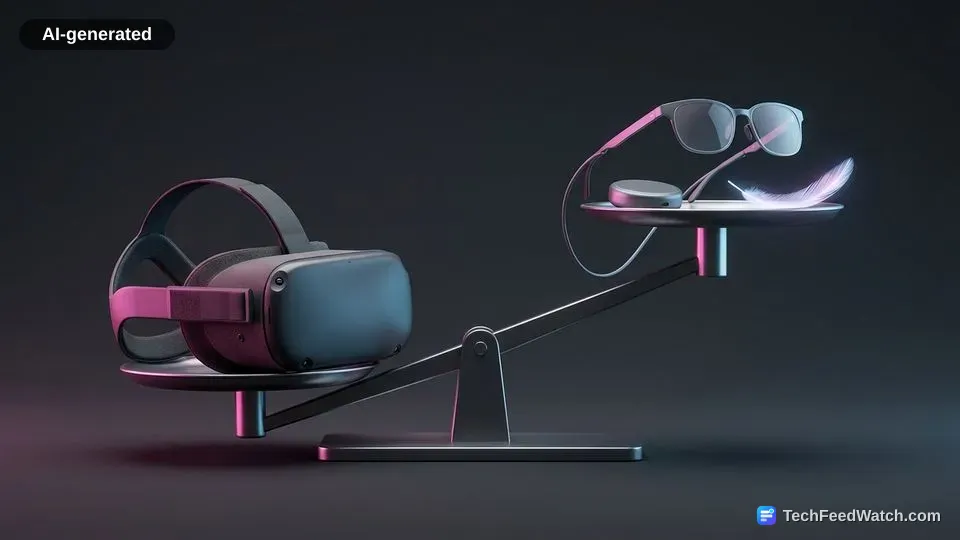
The race to build the best virtual reality goggles is no longer an arms race for wider fields of view or heavier all-in-one enclosures. Bulky, self-contained visors will continue serving dedicated room-scale sim enthusiasts, but they cannot win mainstream daily adoption. The future belongs to lightweight spatial goggles that decouple processing weight from the eyes.
By hitting a 100 g profile, utilizing dense Micro-OLED pancake optics, and anchoring its interface in a mature Horizon OS platform, Meta VR Glasses demonstrate that wearability is the ultimate spec. A 70° horizontal field of view is a compromise, but it is the correct compromise.
Goggles you can comfortably wear for 3 hours of work or video streaming provide infinitely more value than an unwieldy helmet that sits on a shelf after a short session. Erasing the physical burden of spatial computing is the only path forward, and this tethered, high-density architecture sets the benchmark every competitor must now follow.