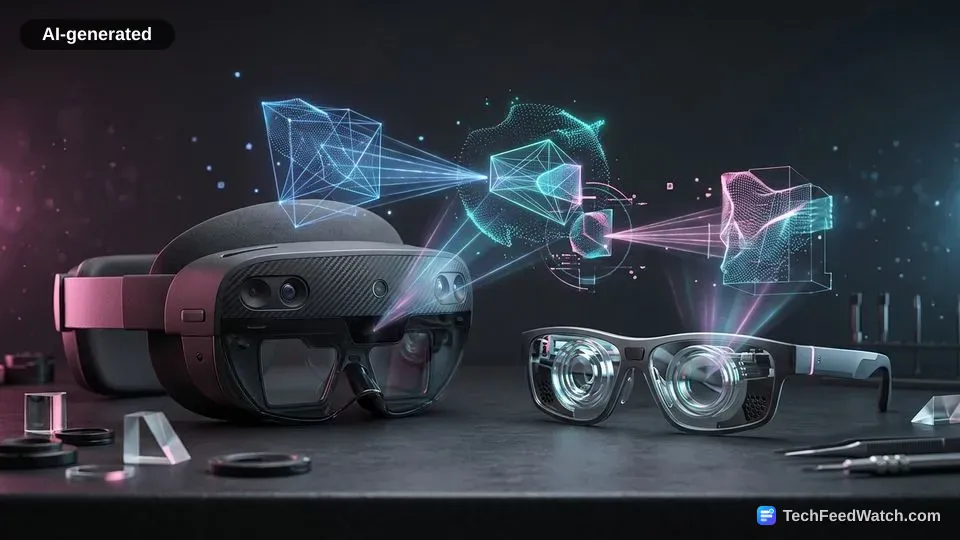
Engineers developed the first working AR systems decades ago
Working augmented reality hardware originated during the mid-20th century rather than the modern smartphone era. Academic and military researchers spent decades constructing early heads-up displays and tracking mechanical rigs before silicon miniaturization enabled commercial applications.
Historical milestones established the technological framework:
- Ivan Sutherland built the first functional head-mounted see-through display system in 1968 at Harvard University, an achievement documented by IEEE computer graphics historical records. Engineers nicknamed the rig “The Sword of Damocles” because its immense physical weight required a mechanical ceiling suspension arm above the user.
- Researcher Louis Rosenberg developed “Virtual Fixtures” at the USAF Armstrong Research Laboratory in 1992, creating one of the earliest working augmented reality platforms. The U.S. Air Force commissioned the project to assist military personnel with precise robotic manipulation through sensory overlays.
- Ronald T. Azuma unified disparate engineering efforts in August 1997 by publishing formal definitions through MIT Press, establishing the technical baseline for modern spatial systems.
These early military and academic systems required room-sized computers, physical gimbals, and complex mechanical tracking rigs. They verified that human vision could process overlaid synthetic data while interacting with real equipment. However, high costs and massive components confined the technology to specialized laboratories throughout the 20th century.
Where is augmented reality used today?
Augmented reality is used today across hundreds of millions of mobile consumer devices, industrial assembly plants, remote field engineering services, and digital retail platforms. Consumers frequently use functional AR tools without recognizing the underlying spatial computing architecture.
Mobile hardware represents the largest deployment footprint. According to Apple, the company launched its developer framework ARKit in 2017 to integrate computer vision, surface detection, and environmental light estimation directly into millions of iOS mobile devices.
Similar platforms on competitor hardware allow users to place furniture into living rooms, preview retail purchases to scale, and play location-based multiplayer video games. The technology also powers live video filters that track facial landmarks with millimeter precision across social media platforms.
Industrial enterprises employ optical systems to solve assembly and repair challenges. Field technicians wear commercial headsets to project step-by-step schematics over complicated electrical panels, eliminating physical manuals during dangerous maintenance procedures.
Surgeons inspect three-dimensional anatomical reconstructions overlaid onto patients during surgical planning. Industrial designers manipulate full-scale holographic car chassis within collaborative spaces, shortening iteration cycles without milling physical clay models.
Hardware hurdles keep sci-fi holographic glasses out of reach
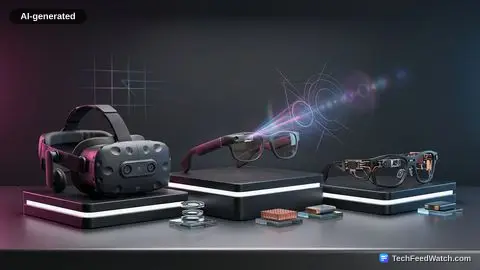
Everyday holographic eyewear styled like ordinary eyeglasses remains unavailable due to unresolved thermal, optical, and battery constraints. Pop culture regularly portrays lightweight spectacles that generate bright, full-color virtual reality graphics across wide angles, but current physics presents significant engineering bottlenecks.
Optics represent the primary obstacle. Waveguide displays bounce light through microscopic glass ridges toward the human eye, losing substantial brightness during internal reflection. Tiny projectors must run at extreme intensity to remain readable in daylight, generating heat that cannot dissipate safely inside lightweight frames resting on human skin.
Wide viewing angles demand thicker glass assemblies, driving up physical weight and straining neck muscles during extended sessions. Battery chemistry compounds the issue: high-draw processors calculating real-time computer vision quickly exhaust miniature cells, forcing designers to choose between bulky battery packs or runtimes measured in minutes.
According to Meta’s Connect keynote on September 25, 2024, the company unveiled “Orion,” an optical see-through AR glasses prototype featuring silicon-carbide lenses, micro-LED projectors, an electromyography (EMG) wristband, and a 70-degree field of view.
Meta stated during the presentation that Orion is strictly a non-commercial research prototype distributed internally and to select developers due to high production costs and miniaturization challenges. Until manufacturing yields improve and component power consumption drops, complete optical spatial computing remains locked behind industrial hardware or internal corporate prototypes.
Make Life Smart reviews five futuristic spatial computing AR glasses
Creator Make Life Smart presents an analysis of how emerging consumer eyewear addresses existing optical limitations, focusing on five modern extended reality products. The video examines devices engineered to bypass current hardware roadblocks, highlighting how manufacturers trade bulkiness for optical performance.
The review examines several dedicated hardware solutions:
- Rokid AR Spatial, which the creator highlights as a spatial computing platform worn as glasses that anchors virtual screens directly to physical room coordinates.
- NPS Envision, built around maximizing field of view to fill peripheral sightlines rather than restricting visuals to a miniature window.
- RayNeo GT Max, utilizing high-brightness display tech designed to maintain image visibility in outdoor lighting conditions.
- Viture Pro 2, which incorporates third-generation display optical engineering termed Ultra Clarity 3.0 to render multiple virtual monitors.
- Meta hardware platforms, showing how mature software platforms and application ecosystems support prolonged productivity workflows.
While Meta develops experimental research hardware like Orion to test wide fields of view, consumer companies like Rokid, RayNeo, and Viture target targeted use cases like multi-screen productivity and cinema viewing.
The creator notes that modern glasses achieve high visual clarity by tethering to external computational pucks or host phones, avoiding thermal overload inside the temple arms. These consumer solutions verify that augmented reality hardware exists on store shelves today, provided buyers accept optical and design compromises rather than expecting science-fiction holograms.