What Qubits Can Be Means for Quantum Computing

Researched with a video published on YouTube by Quantum SystemHub. TechFeedWatch is not affiliated with the creator, and all rights to the video remain theirs.

A qubit can exist in a continuous, mathematically weighted superposition of states rather than just a static binary switch. By using probability amplitudes across the Bloch sphere, quantum processors manipulate overlapping wave states using interference before measurement collapses them into classical values. Understanding this mechanism clarifies why quantum systems scale exponentially to evaluate complex problems without resorting to science-fiction tropes.

In physical terms, qubits can be any quantum two-level system prepared in a continuous, weighted blend of states rather than a fixed binary position. Unlike a classical bit restricted to an absolute zero or one, an unmeasured qubit occupies a defined mathematical superposition where both outcomes remain active possibilities with specific probability weights.

What It Is and What Qubits Can Be

Popular culture frequently misrepresents quantum computing as an exotic trick where a unit of data is somehow zero and one at the exact same moment. Observers often invoke Schrödinger’s cat, claiming the machine operates inside an impossible paradox where data lives simultaneously alive and dead.

Treating a qubit like it is a window into a parallel universe, or just a normal bit that flickers rapidly between two classical states, is a massive misconception. Physical systems do not operate by oscillating frantically between binary outputs to mimic duality.

Instead, a classical bit functions like an everyday household light switch. It snaps strictly into an off position representing zero, or an on position representing one. Every classical text file, operating system, and digital video relies on billions of these physical gates set to discrete voltages.

A qubit acts much more like an advanced dimmer switch. Rather than adjusting physical illumination, however, this switch adjusts probability. It rests in a newly defined state that spans the entire mathematical space between zero and one.

Formally, quantum superposition is a quantum system’s ability to exist in a weighted combination of multiple possible states until it is measured. The operational word here is weighted.

Superposition does not mandate a blind 50/50 split between options. A qubit can lean heavily toward zero, or tilt sharply toward one, establishing a physical reality where potential configurations overlay one another.

To grasp this distinction, consider flipping a standard coin and catching it against your wrist. Classically, there is a 50% chance of heads and a 50% chance of tails.

Yet underneath your hand, the physical coin already rests at 100% heads or 100% tails. The probability reflects human ignorance rather than physical ambiguity. A qubit in superposition differs fundamentally: it has not settled on an outcome yet.

It holds a genuine blend of both possibilities, allowing those mathematical possibilities to interact directly during calculation. For a wider perspective on structural definitions, see our guide on Qubit in Quantum Computing Explained for Modern Scale.

Physicists visualize this state using a geometric model called the Bloch sphere, which operates like a geographic globe. Imagine the Earth: the North Pole represents a definite classical state of zero, while the South Pole represents a definite state of one.

A classical bit acts like an immobile traveler who can only stand at the North Pole or the South Pole, strictly forbidden from setting foot anywhere else. A qubit, by contrast, behaves like an explorer with full freedom across the planet.

As long as the qubit remains isolated and unmeasured, it can occupy any coordinate on the sphere’s surface. Every single latitude and longitude on that globe forms a valid, unique quantum state.

Watch: the video

10 min video by Quantum SystemHub.

How It Works

A qubit’s position on the Bloch sphere is defined by values called probability amplitudes. These amplitudes serve as the mathematical weights governing the system.

The latitude, measuring the angle down from the North Pole, sets the numerical balance between zero and one. The longitude around the equator establishes the phase, a wave property that enables qubits to interact computationally.

Consider a practical coordinate on this globe. If a laboratory sets a qubit at a specific latitude in the Southern Hemisphere, its probability amplitudes are mathematically weighted before readout.

As Quantum SystemHub points out, an unmeasured qubit positioned at this coordinate has exactly a 64% chance it will show up as a one and a 36% chance it will show up as a zero upon measurement.

The system does not guess randomly; it preserves a precise mathematical ratio. Physicists at Caltech captured this counterintuitive mechanic cleanly: everything that can happen in quantum mechanics does happen until you check.

When engineers finally check the qubit by running an experimental readout, the delicate state encounters measurement collapse. An observer cannot scan the sphere to inspect the exact coordinates. Probing the particle forces it to make an absolute binary decision.

The traveler instantly snaps to either the North Pole or the South Pole. At that exact moment, the superposition is permanently destroyed. The multidimensional probability vanishes, leaving behind a standard classical bit.

Because observation erases this rich information, quantum computers cannot simply read intermediate parallel states. They must complete calculations in the dark. Engineers manage this challenge through quantum interference.

Because probability amplitudes behave mathematically like waves, they can overlap and interact. Algorithms choreograph these waves like overlapping ripples in a pond.

By applying targeted gate operations, the algorithm creates constructive interference to amplify the amplitude of the correct answer. Simultaneously, it generates destructive interference so the amplitudes of incorrect answers flatten to zero.

This mechanism dictates the complete lifecycle of a quantum algorithm:

  1. Technicians initialize the qubits into superposition, effectively placing the traveler along the equator of the Bloch sphere.
  2. The processor evolves the system using logic gates, driving constructive and destructive interference to steer the traveler across coordinates.
  3. The hardware measures the register, collapsing the amplitudes so the traveler snaps to the pole holding the choreographed solution.

Hardware developers execute this process using real microscopic systems. In spin-based architectures, computers utilize electron spins, treating the electron like a tiny directional magnet. Pointing up in the laboratory corresponds to the North Pole, pointing down represents the South Pole, and pointing sideways represents superposition.

This design opens up exponential information capacity. When connected, $n$ qubits express $2$ to the power of $n$ possibilities simultaneously. Just three qubits can evaluate eight paths simultaneously.

Pushing the hardware further, a register of 300 qubits can evaluate more possibilities at once than there are atoms in the observable universe. To understand why hardware setups struggle to stabilize these fragile states, review The Engineering Roadblocks to Scalable Qubits and see Why Qubits Are Useful in Complex Computing.

Who Benefits from Quantum States and Who Does Not

Quantum states deliver massive value to narrow, computationally intractable challenges, but offer little utility for general consumer computing.

Organizations that benefit include:

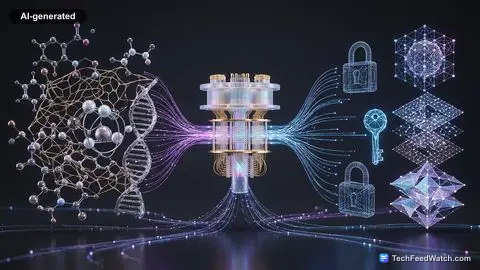
  • Molecular chemists simulating atomic bonds, where quantum phase interactions mimic natural subatomic behavior.
  • Supply chain analysts executing route optimization across massive combinatorial networks.
  • Cryptographers evaluating lattice structures and historical public-key durability.

Users who will not benefit include:

  • Everyday consumers running operating systems, media players, or standard office software.
  • Web servers running straightforward linear database queries, where classical bit switches operate faster and cheaper.
  • Standard software teams without access to quantum compilers; mastering this hardware requires distinct architectures, as outlined in Why Quantum Computing Needs New Programming Logic.

How Qubits Turn Physics into Exponential Calculation Power

A qubit is neither a classical switch flickering between states nor a doorway into science fiction. It is a controllable physical system that stores continuous, wave-like probability amplitudes across spherical dimensions. By using interference to steer these weights before measurement forces a collapse, quantum computing converts raw physics into exponential calculation power.
Frequently Asked Questions

What can a qubit be compared to in classical computing?

While a classical bit acts like a standard light switch that is strictly off or on, a qubit functions like a dimmer switch that adjusts mathematical probabilities across a spectrum. It exists in a weighted superposition between zero and one until read by an instrument.

Does a qubit flicker between zero and one simultaneously?

No, treating a qubit as flickering rapidly between states or accessing parallel universes is a common misconception. A qubit rests in a single, well-defined physical state that holds continuous probability amplitudes for both outcomes at once.

What happens when you measure a qubit?

Measuring a qubit forces its probability state to collapse instantly into a definite zero or one. This observation permanently destroys the superposition, resetting the system to classical certainty.

How do quantum algorithms extract answers if measurement collapses the qubit?

Algorithms use constructive and destructive interference to amplify the probability of the correct answer while canceling out incorrect paths before measurement. When read, the qubit snaps to the pole representing the choreographed solution.

Jacob S. Olsen

Jacob S. Olsen

Runs TechFeedWatch, from Denmark

How this article was made: every article starts from two things — a question people search for on Google, and a video from an independent creator on that subject. A language model writes the article to answer the question, using the video's transcript as its research material. It publishes automatically — I do not read every article before it goes live. The creator is credited on this page.

What is mine is the machinery and the rules it follows: which subjects, which sources, what gets rejected, and what this site is allowed to claim. More on that here — and if something is wrong, tell me.