How It Works
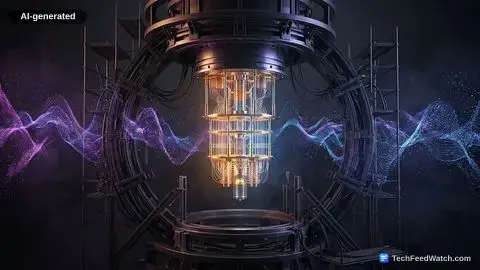
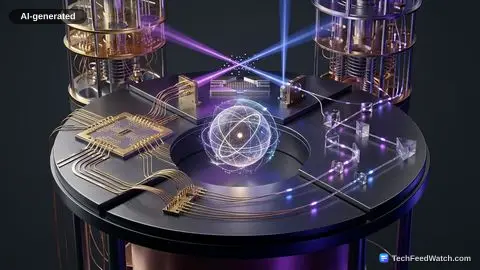
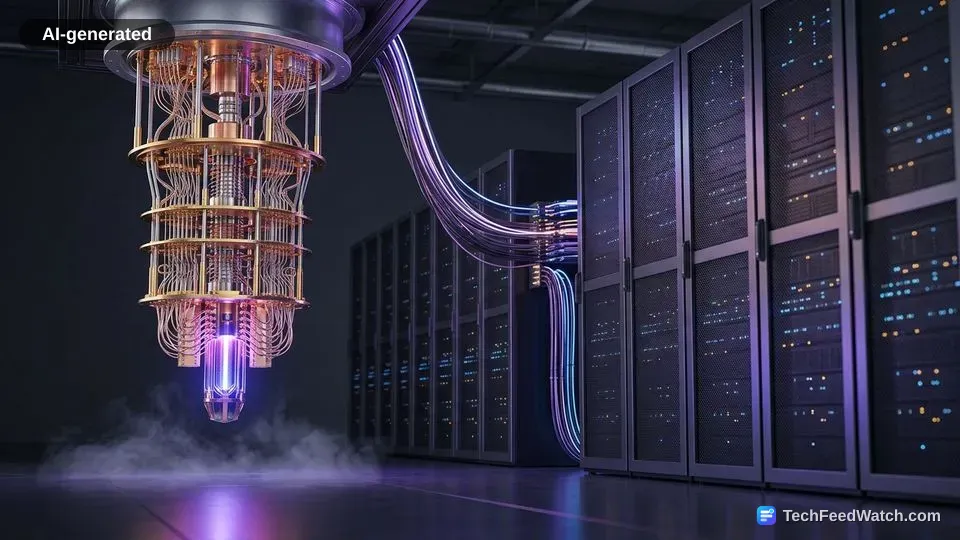
Building quantum capability into modern facilities requires solving severe physical and networking constraints. Qubits suffer from decoherence, losing their state when exposed to minor temperature shifts, physical vibration, or electromagnetic noise. Traditional superconducting qubits require dilution refrigerators that drop operating environments near absolute zero.
Classical server rooms balance airflow and liquid loops for heat dissipation, where cooling consumes 10 to 30% of the electronic load. Quantum installations flip this dynamic, allowing cryogenic cooling to dominate the power budget.
Cryogenic scaling faces hard physical limits. A 2026 paper from Oak Ridge National Laboratory pointed out that scaling superconducting systems faces supply bottlenecks around helium-3, an isotope required to hit millikelvin temperatures, long before hitting architectural limits.
As the YouTube channel Quantum City points out, what the industry is witnessing is every data center built on classical computing assumptions being handed an expiration date, forcing operators to reconsider facility design.
Hardware vendors are pursuing distinct engineering approaches to overcome these physical barriers:
- Topological Cores: Microsoft introduced Majorana 1, a quantum processor powered by a topological core designed to scale to a million qubits on a single chip. Built on an engineered material stack of indium arsenide and aluminum developed over nearly 20 years, Majorana 1 stores quantum data in the topological properties of quasi-particles rather than a single physical point, creating hardware-level noise protection.
- Neutral-Atom Traps: Researchers at Caltech demonstrated an alternative path by splitting a laser beam into 12,000 parts to trap 6,100 cesium atoms as qubits. These qubits held superposition for 13 seconds, ten times longer than prior arrays. This optical method sidesteps extreme cryogenic cooling while allowing physical repositioning of qubits during operation.
- Logical Qubit Scaling: IBM committed to building Quantum Starling by 2029, a fault-tolerant system featuring 200 logical qubits capable of executing 100 million quantum operations. IBM uses Quantum Low-Density Parity-Check (QLDPC) codes to cut physical qubit overhead by up to 90%, paving the way for its planned Blue Jay system in 2033 with 2,000 logical qubits. Intermediate hardware markers include Loon in 2025, Kookaburra in 2026, and Cockatoo in 2027. Tracking which hardware defines quantum computing chips today shows how quickly these physical architectures are advancing.
Connecting these sensitive quantum processors to existing GPU infrastructure is essential for real-world integration. In October 2025, NVIDIA announced NVQLink, an interconnect system linking classical GPUs to quantum hardware with round-trip latencies below 4 microseconds. In a demonstration pairing an NVIDIA Grace Hopper Superchip with Quantinuum’s Helios processor, NVQLink executed real-time error correction 32 times faster than required thresholds.
This bridge proves that future server halls will not choose between GPUs and qubits; they will link them across high-speed system buses. Analyzing a qubit in quantum computing explained for modern scale reveals why hybrid integration remains the only viable deployment route.
Industries That Benefit from Quantum Computing
The transition to hybrid quantum facilities directly impacts sectors managing massive mathematical complexity, while standard enterprise operations will remain on classical silicon.
S&P Global reports that global quantum investment passed $55 billion in 2025, with revenues projected to expand from $2.5 billion in 2025 to nearly $9 billion in 2026. A survey from 451 Research found that 76% of technology leaders expect quantum hardware to generate tangible business value within five years.
Understanding do we know what quantum computers are used for clarifies which industries benefit:
- Pharmaceuticals and Biotechnology: Research teams simulate molecular interactions, protein folding, and chemical syntheses without wet-lab bottlenecks.
- Financial Services: Quantitative institutions execute complex risk assessments, arbitrage models, and Monte Carlo portfolio balancing in real time.
- Energy and Materials Science: Chemical plants design improved catalysts, develop high-density battery chemistries, and advance direct carbon capture materials.
- National Security: Government research hubs analyze advanced cryptographic methods and sensor arrays.
Organizations running web platforms, e-commerce stores, content delivery networks, and basic enterprise resource planning gain no advantage from quantum processors. These companies will continue leasing traditional cloud instances on standard silicon.
Why Quantum Computing Will Not Replace Data Centers
Quantum computing will not replace classical data centers, but it will fundamentally change how high-performance facilities operate. Industry bodies like the Quantum Data Center Alliance, founded in 2025, are already designing standards across interconnects, cryogenic integration, and hybrid middleware.
Rather than replacing server racks, quantum processors will anchor specialized zones within traditional facilities, handling complex mathematical calculations while classical GPUs and CPUs manage everything else. The future data center is not purely quantum; it is a unified, hybrid machine.